
Saffron: Benefits, Uses and How to Use the World’s Most Expensive Spice
IMPORTANT: Saffron is safe in the small amounts used in cooking (a pinch, a few threads). Large doses, above 1.5 grams per day, can become toxic, and amounts over 5 grams are considered dangerous. Pregnant women should avoid large quantities of saffron, as folk tradition and some observations associate it with uterine stimulation. People taking antidepressants or blood thinners, or those with bipolar disorder, should consult a doctor before using saffron as a supplement. This article is for informational purposes and does not replace the advice of a doctor or pharmacist.
The Story of the Threads of Gold
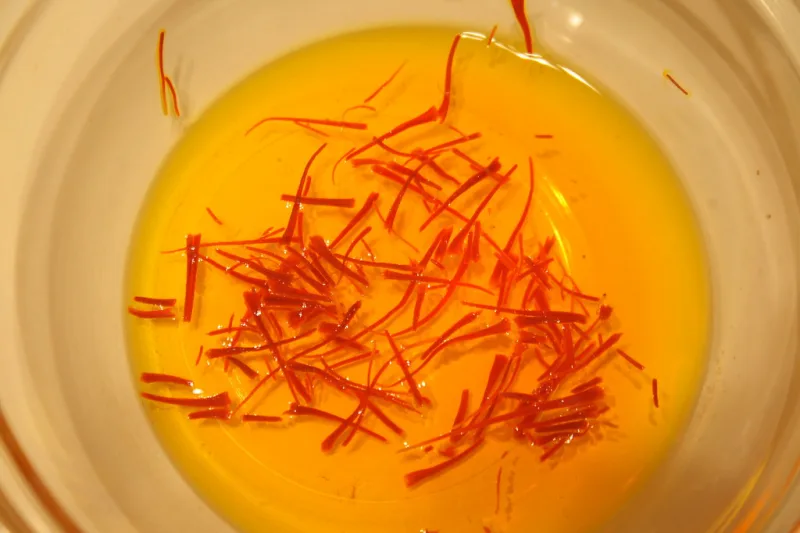
When I was a child, I spent my summers at Grandma Saveta’s, in a village in the south of the country, where every housewife kept a small jar hidden in the spice cupboard. Grandma’s was made of dark glass, with a cork stopper, and it was only opened on holidays. “This is my gold,” she would say with a smile, carefully drawing out a few thin, brick-red threads that seemed far too fragile to hold any power. She would place them in a spoonful of warm water, and within minutes the water turned golden, like an autumn sunset. She poured that fragrant water into the rice for our Easter table or into the milk cake she baked for guests.
Later, I learned that Grandma did not use saffron only for color and aroma. Whenever someone in the house was sad, wilted, “heavy-hearted,” as she put it, she would prepare a cup of warm milk with a few threads of saffron and a teaspoon of honey. “It cheers you from the inside,” she’d say, and as a child I thought she meant the taste. Only as an adult did I understand that folk traditions in many corners of the world used saffron for exactly this: as a gentle balm for a burdened spirit. And what Grandma simply called “cheer from the inside” is beginning to attract the interest of researchers as well.
What Saffron Is
Saffron is a spice obtained from the stigmas of the Crocus sativus flower, a plant in the iris family that blooms in autumn with delicate violet-purple petals. Each flower produces only three red stigmas, and these must be picked by hand, early in the morning, before the sun wilts them. To obtain a single gram of dried saffron, roughly 150 flowers are needed, and a kilogram requires hundreds of thousands of flowers picked one by one. This explains why saffron is, by far, the most expensive spice in the world, often surpassing in price, gram for gram, many precious metals.
Originating in the Middle East and Southwest Asia, saffron has been cultivated for thousands of years in Iran, India, Greece, Spain and Morocco. Iran remains the world’s largest producer, but high-quality saffron is also found in the Spanish region of La Mancha or in Kashmir. Throughout history, saffron has been used not only as a spice and food coloring, but also as a dye for royal garments, as a perfume and as a remedy in traditional Persian, Ayurvedic and Greco-Roman medicine.
What makes saffron so special is not only its rarity but its complex aromatic profile: a combination of floral, slightly bitter notes, fresh hay and honey, with an astonishing ability to color any dish a golden yellow, even in minuscule amounts.
Table of Contents
- Composition and Active Compounds
- Health Benefits
- Traditional Uses
- How to Use Saffron Correctly
- Step-by-Step Recipes
- Dosage and How to Take It
- How to Recognize Authentic Saffron
- Practical Tips and Common Mistakes
- Conclusion
- Frequently Asked Questions
Composition and Active Compounds
Saffron’s color, aroma and effects come from three main compounds, each with its own role:
Crocin is the pigment responsible for the intense golden color. It is a water-soluble carotenoid, which means it is easily released into hot liquids. Crocin is also one of saffron’s main antioxidants, which is why it has drawn the attention of researchers interested in cellular protection.
Safranal gives saffron its characteristic aroma. It is a volatile substance, the one you sense the moment you open the jar. The fresher and better-stored the saffron, the more safranal it contains and the stronger it smells.
Picrocrocin is responsible for the slightly bitter, characteristic taste. Through drying and storage, picrocrocin partly converts into safranal, which explains why saffron’s aroma changes over time.
Besides these three core compounds, saffron contains flavonoids, B-group vitamins, small amounts of vitamin C, manganese, potassium and iron. It must be said clearly, however: because of the tiny quantities used, saffron is not a significant source of vitamins or minerals in the diet. Its value lies in its concentrated bioactive compounds, not in its actual nutritional contribution.
Health Benefits
Supporting a Good Mood
Saffron’s best-known reputation, both in folk tradition and in current research interest, is tied to mood. The Persians called it “the spice of happiness,” and in many cultures it was customary to offer saffron milk to those who were downcast. Studies suggest that certain compounds in saffron may have a supportive effect on balanced mood, possibly by influencing how the body manages some substances linked to well-being. It is important to stress that saffron is not a treatment for depression and does not replace prescribed therapy or medication; at most, it can be a gentle support within a healthy lifestyle and under the guidance of a specialist.
A Source of Antioxidants
Crocin, crocetin and safranal are antioxidants that help the body cope with oxidative stress, that is, the action of free radicals that contribute to cellular aging. A diet rich in antioxidants, which colorful spices can be part of, is generally associated with better long-term health. Saffron brings these compounds in a concentrated form, even if in small amounts.
Support for Eye Health
Tradition and some observations suggest that the carotenoid antioxidants in saffron may be friendly to eye health, particularly the retina. Carotenoids are generally known for their role in protecting vision, and saffron provides a variety of them. Of course, eye health depends on a varied diet overall, not on a single spice.
Digestive Comfort
In traditional medicine, saffron was used to soothe the stomach and to stimulate appetite. Its warm, slightly bitter aroma has a tonic effect on digestion, and a mild saffron tea was considered by the elders a gentle remedy for bloating and discomfort after heavy meals.
Support for Menstrual Comfort
In the folk tradition of several cultures, saffron was recommended to women to ease the discomfort of difficult days of the cycle, both cramps and the associated irritability. This benefit should be viewed with caution and in small doses, keeping in mind the warning about large amounts during pregnancy.
A Feeling of Satiety
There is a traditional belief, supported by some observations, that saffron may help reduce cravings for snacks and promote a feeling of fullness, and it is sometimes included in the habits of those watching their weight. It is not a weight-loss solution but, at most, a small aid within a balanced diet.
Traditional Uses
In the traditional household, saffron led a double life: in the kitchen and in the remedy chest.
In the kitchen, it was indispensable in festive dishes. It colored and perfumed rice, sweet bread, milk-and-egg cakes, and holiday soups. In Persian cuisine it tints the rice, in Spanish cuisine it is the soul of paella, in Italian cuisine it colors Milanese risotto, and in northern Europe it flavors sweet breads and winter buns.
As a remedy, saffron found its way into soothing warm drinks: saffron milk with honey for sleep and mood, a mild saffron infusion for digestion, compresses of saffron water for the inflamed gums of teething children. Grandmothers also used golden saffron water as a tonic for the complexion, gently dabbing tired skin.
How to Use Saffron Correctly
The secret to using saffron lies not in quantity but in technique. Because it is so concentrated and expensive, every thread counts, and the correct method makes the difference between a golden, fragrant dish and a bland one in which the costly threads go unnoticed.
Pre-soaking is the key. Saffron threads are not added dry directly to food, because they do not have time to release their color and aroma. Instead, they are left to steep for a few minutes (ideally 15-20, or even longer) in a warm but not boiling liquid: warm water, warm milk or broth. The liquid turns golden, and only then is it added, threads and all, to the dish.
Light crushing helps. Some cooks lightly grind the dry threads in a mortar or crumble them between their fingers before soaking, to release the pigments faster. Be careful, however, not to turn them into a fine powder, so as not to lose any.
A small quantity: for a dish meant for a family (4-6 servings), a pinch, that is roughly 15-20 threads, is usually enough. More does not mean better, only bitterness and waste.
Step-by-Step Recipes
Warm Saffron Milk (for the Evening and for Mood)
This is the soothing drink from Grandma Saveta’s story.
- Heat a cup of milk (plant-based or dairy) without bringing it to a boil.
- Add 5-7 saffron threads and keep over very low heat for 3-4 minutes, stirring gently.
- Turn off the heat and let it stand, covered, for another 5 minutes, so the aroma and color are fully released.
- Sweeten with a teaspoon of honey and, if you like, add a pinch of cinnamon or cardamom.
- Drink warm, in small sips, in the evening, as a little relaxation ritual.
Saffron Water (the Base for Cooking)
- Place a pinch of saffron threads (15-20) in a small bowl.
- Pour over them 3-4 tablespoons of warm (not boiling) water.
- Cover and let stand for 20 minutes, until the water turns deeply golden.
- Use both the liquid and the threads in rice, soups, sauces or doughs.
Golden Saffron Rice
- Prepare the saffron water in advance (see above).
- Rinse the rice and cook it as usual, in lightly salted water.
- A few minutes before the end, pour the saffron water, threads and all, over the rice and stir gently.
- Cover and let the rice rest for 5 minutes, so it takes on the color evenly.
- Serve alongside chicken, fish or vegetable dishes.
Mild Saffron Infusion for Digestion
- Place 4-5 saffron threads in a cup.
- Pour over hot, but not boiling, water and cover.
- Let steep for 8-10 minutes.
- Drink lukewarm, after a heavier meal, perhaps sweetened with a little honey. Do not exceed one or two cups per day.
Dosage and How to Take It
In cooking, the doses are small and safe: a pinch for an entire dish. For use as a gentle remedy (saffron milk, infusion), an amount of 5-15 threads per day is generally considered reasonable for a healthy adult.
The golden rule is moderation. The total amount of saffron consumed in a day should not, by much, exceed half a gram in ordinary food use. Doses above 1.5 grams per day can cause unpleasant effects (dizziness, nausea, dry mouth), and very large doses are downright dangerous. More brings no additional benefits, only risks and needless expense.
How to Recognize Authentic Saffron
Being so expensive, saffron is also one of the most adulterated spices. Here are a few markers:
- Appearance: authentic threads are thin, elongated, an intense brick-red, with a small, lighter, trumpet-shaped end. Threads that are completely uniform, bright red and thick may be artificially dyed.
- The water test: place a few threads in warm water. Real saffron releases its color gradually, over a few minutes, leaving the threads intact and red. Fake dyes cloud the water instantly and the threads lose their color.
- The aroma: authentic saffron has a floral scent of hay and honey, never chemical or overly sweet.
- The taste: it is slightly bitter, never sweet. If the threads taste sweet, they are probably adulterated.
- The price: suspiciously cheap saffron is almost certainly fake or of inferior quality.
Prefer saffron sold as whole threads, not powder, because powder is far easier to adulterate (with turmeric, safflower or other dyes).
Lifestyle and Practical Advice
Saffron is not a cure-all but a small fragrant joy that fits beautifully into a balanced lifestyle. Used in moderation, it turns an ordinary meal into a festive one and adds a touch of color and sensory pleasure to everyday life.
Store it correctly: in an airtight container, away from light, heat and moisture. Light and air destroy its aroma over time. A dark jar in a cool cupboard is ideal. This way it keeps its qualities for up to two years, though it is most fragrant in the first year.
Pair it with simple pleasures: a cup of saffron milk in the evening, golden rice for Sunday lunch, a fragrant cake for guests. The joy of using a rare spice with purpose and measure is part of its charm.
Practical Tips and Common Mistakes
Mistake no. 1: Adding dry threads directly to food. Without pre-soaking, saffron does not have time to release its color and aroma, and the costly threads go unnoticed. Always steep them in a warm liquid first.
Mistake no. 2: Using boiling water. Vigorously boiling water can destroy some of the delicate aromatic compounds. Use warm to hot water, but not boiling.
Mistake no. 3: Overdoing the quantity. Many believe that more saffron means better flavor. The truth is the opposite: too much saffron gives a bitter, medicinal, unpleasant taste, and wastes an expensive product.
Mistake no. 4: Buying cheap saffron powder. Cheap powder is almost always adulterated. Invest in whole threads from a trusted supplier.
Mistake no. 5: Storing it in the light. A clear jar left out on the counter quickly loses its aroma. Keep saffron in the dark.
Mistake no. 6: Using large doses as a “supplement.” Consuming saffron in large amounts in the hope of quick benefits is a mistake that can become dangerous. Respect moderation.
Conclusion
Saffron is more than the most expensive spice in the world; it is a small treasure of aroma, color and tradition. Used in moderation, it brings antioxidants, perfumes festive dishes and, according to folk tradition and current research interest, can be a gentle support for a good mood. The secret lies in using it correctly: pre-soaking, small quantities and careful storage. As Grandma Saveta used to say, “it cheers you from the inside,” as long as you respect it and do not waste it. Think of it as a liquid gold of autumn, which you bring into the light on special days and use with gratitude.
Frequently Asked Questions
Why is saffron so expensive? Because it is harvested exclusively by hand, from the stigmas of the crocus flower, and a single gram requires roughly 150 flowers. The intensive labor and very low yield explain the high price, gram for gram, often higher than that of many precious metals.
How many saffron threads can I use per day? For culinary use and as a gentle remedy, 5-15 threads per day are generally considered safe for a healthy adult. Do not exceed half a gram per day by much, and doses above 1.5 grams can become toxic.
Can I use saffron during pregnancy? In the small amounts used in cooking, saffron is usually tolerated, but large quantities should be avoided during pregnancy, as tradition and some observations associate it with uterine stimulation. Always consult your doctor.
How can I tell if saffron is authentic? Authentic threads are thin, brick-red, slightly bitter in taste and floral in scent. The warm-water test is revealing: real saffron releases its color gradually, the threads staying intact and red, while fakes color the water instantly and lose their color.
Does saffron really help with mood? Folk tradition and current research interest suggest a possible supportive effect on balanced mood, but saffron is not a treatment for depression and does not replace therapy or medication. At most, it can be a gentle support within a healthy lifestyle.
Can I replace saffron with turmeric or safflower? These spices can give a similar yellowish color, but they lack the complex aroma of real saffron. They are substitutes for color, not for taste or properties.
How do I store saffron so it does not lose its aroma? In an airtight, opaque container, away from light, heat and moisture, in a cool cupboard. This way it keeps its qualities for about two years, though it is most fragrant in the first year.
Can I give children saffron milk? In very small amounts, milk lightly flavored with a few saffron threads is usually tolerated by children, but avoid large doses and consult your pediatrician if in doubt or if any reactions occur.