 Photo: Sanjay Acharya, CC BY-SA 4.0, via Wikimedia Commons
Star anise (badian, Illicium verum) is the dried, eight-pointed fruit of an evergreen tree native to southern China and Vietnam. In culinary amounts it eases digestion, reduces bloating and soothes coughs thanks to anethole, the same aromatic compound found in common anise. There is one important catch: it should never be given to babies or young children, and the real danger comes from confusion with Japanese star anise, a toxic species.
In Romanian kitchens it shows up mostly in winter, in mulled wine, fruit compotes and festive breads, while in Asia it is a staple of broths, braised meats and Chinese five-spice powder. Below you will find what the research says, what belongs to tradition only, how to prepare tea and syrup properly, and who should avoid it.
Key takeaways
- Star anise essential oil is 80-90% anethole, which gives the licorice-like sweetness and the carminative (anti-gas) effect.
- Traditionally it is used for bloating, mild abdominal cramps in adults and productive coughs.
- The shikimic acid in the pods is the industrial starting material for oseltamivir, but that does NOT mean the tea treats flu.
- Do not give it to infants or children under 6: poisonings have been reported, mostly linked to contamination with Japanese star anise.
- Usual amount: 1 star per cup of tea or 2-3 stars per pot of food.
What star anise is
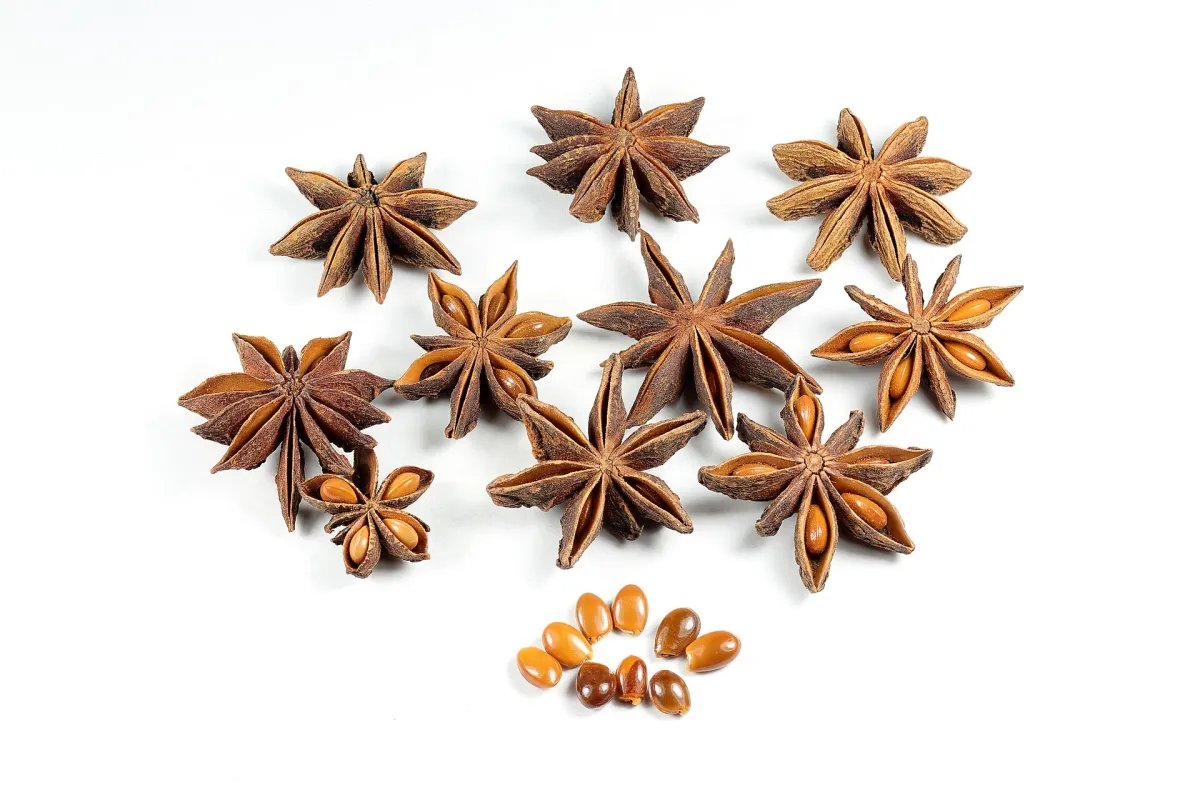
Star anise comes from Illicium verum, a tree in the Schisandraceae family that grows in southern China and northern Vietnam. The fruits are picked green, before full ripeness, and sun-dried until they turn reddish brown, keeping their star shape with 6-10 carpels (usually 8). Each point of the star holds one glossy seed.
Although it tastes like green anise (Pimpinella anisum), the two plants are not related. Common anise is a herb from the carrot family, which we cover separately in our article on anise. Star anise has a stronger, rounder flavor with licorice notes and a slightly bitter finish.
Chinese star anise vs. Japanese star anise
This is the single most important safety point in the article. Japanese star anise (Illicium anisatum, also called shikimi) looks almost identical but contains anisatin, a neurotoxin that can cause vomiting, agitation, tremors and seizures. In 2003 the US FDA issued an advisory against star anise teas after poisonings in infants, partly linked to contamination with the Japanese species.
Rough differences (not enough for reliable home identification):
| Feature | Chinese star anise (I. verum) | Japanese star anise (I. anisatum) |
|---|---|---|
| Smell | sweet, anise-like, pleasant | faint, cardamom- or turpentine-like |
| Shape | plump carpels, rounded tips | thinner carpels, sharp curved tips |
| Taste | sweet and aromatic | bitter, unpleasant |
| Use | food spice | ornamental only, toxic |
The practical conclusion: buy star anise only from reputable food brands, not unlabeled bulk of uncertain origin, and never use stars from decorations or potpourri.
Active compounds
- Anethole (trans-anethole): the main component of the essential oil (the oil makes up 5-8% of the fruit). Carminative, mildly antispasmodic and expectorant.
- Shikimic acid: present in high amounts (up to several percent), used industrially to synthesize oseltamivir (Tamiflu). In the whole fruit it has no proven antiviral effect in humans.
- Estragole, limonene, linalool: minor aromatic compounds.
- Flavonoids and phenolic compounds: antioxidant activity in laboratory studies.
Benefits: tradition vs. research
Digestion, bloating and gas
This is the best-supported use. Anethole relaxes intestinal smooth muscle and helps expel gas, which is why star anise appears in traditional Chinese medicine for “cold stomach”, cramps and nausea. The effect resembles that of fennel and anise, plants for which the European Medicines Agency (EMA) recognizes traditional use in mild digestive complaints. For frequent bloating see also our guide to bloating.
Coughs and colds
Anethole is mildly expectorant and helps thin mucus. Star anise oil has traditionally been used in cough lozenges and syrups. A warm star anise tea with honey and lemon is a reasonable comfort remedy for adults. There is no evidence that it shortens the flu.
The “natural Tamiflu” myth
A popular claim says star anise tea works as an antiviral because oseltamivir is made from its shikimic acid. That is a misunderstanding: shikimic acid must be chemically converted in several steps to become the drug. No oseltamivir ends up in your tea. If you have confirmed flu and belong to a risk group, antiviral treatment is something only your doctor should prescribe.
Antimicrobial and antioxidant effects
Lab studies show that star anise extracts and oil inhibit some bacteria and fungi and have antioxidant activity. These are in vitro results, useful for food preservation, but they cannot be directly translated into effects in humans.
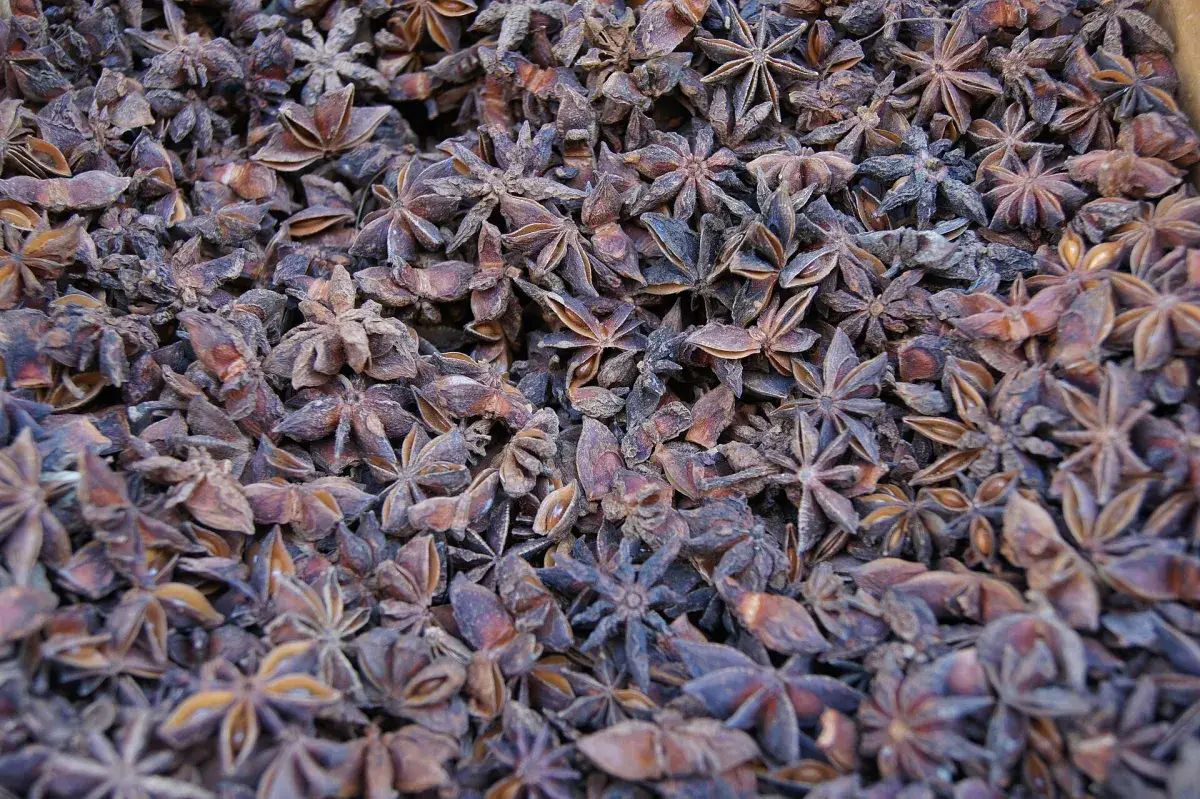 Photo: Jebulon, Public domain, via Wikimedia Commons
How to use it in the kitchen
Star anise is potent: a single star flavors a whole pot. Add it whole and remove it before serving, or grind it finely and use very little.
- Mulled wine: 1-2 stars per 750 ml wine, with cinnamon, cloves and orange peel. Warm gently without boiling.
- Pear or plum compote: 1 star per liter of water, simmered 10 minutes.
- Pho and Asian broths: 2-3 stars toasted briefly in a dry pan, then simmered in the stock.
- Braised pork or duck: 1-2 stars in a soy sauce, ginger and garlic braise.
- Sweet breads, gingerbread, biscuits: ¼ teaspoon of powder per 500 g flour.
- Chinese five-spice: star anise, Sichuan pepper, cloves, cassia cinnamon and fennel seeds in equal parts.
Remedy recipes for adults
Star anise tea for digestion
- Place 1 whole star (about 1 g) or ½ teaspoon of crushed pods in a mug.
- Pour over 250 ml boiling water.
- Cover and steep for 10 minutes (covering keeps the volatile oil in).
- Strain and drink after meals, once or twice a day.
Variation: add ½ teaspoon of fennel seeds for a broader carminative effect.
Cough tea with ginger and honey
- Simmer 300 ml water with 1 star anise and 3-4 slices of fresh ginger for 5 minutes on low heat.
- Remove from the heat and let it cool below 40°C.
- Stir in 1 teaspoon of honey and the juice of ¼ lemon.
- Drink warm 2-3 times a day, for no more than 5-7 days.
Simple homemade syrup
Simmer 3 stars in 250 ml water for 10 minutes, strain and mix the lukewarm liquid with 250 g honey. Keep refrigerated for up to 2 weeks. Adult dose: 1 teaspoon three times a day. For more variations see our article on homemade cough syrups.
Dosage guide
| Form | Adult amount | Frequency | Duration |
|---|---|---|---|
| Whole star in tea | 1 star (about 1 g) / 250 ml | 1-3 cups a day | up to 2 weeks |
| Powder in food | ¼-½ teaspoon per family dish | occasionally | no limit, as food |
| Honey syrup | 1 teaspoon | 3 times a day | 5-7 days |
| Essential oil | do not swallow at home | - | external use only, diluted |
The traditional total daily amount of dried fruit is around 3 g. More does not mean more effective, just more anethole, which can be irritating in excess.
Contraindications and interactions
- Infants and young children: do NOT give star anise tea to babies (including for colic) or to children under 6. Reported infant poisonings included irritability, vomiting, abnormal eye movements and seizures.
- Pregnancy and breastfeeding: culinary amounts are considered acceptable; daily teas, concentrated syrups and essential oil should be avoided.
- Allergy: people allergic to anise, fennel or other aromatic spices may react to star anise as well.
- Epilepsy: avoid the essential oil and large amounts because of a theoretical risk of lowering the seizure threshold.
- Estrogen-sensitive conditions: anethole has weak estrogenic activity; with hormone-dependent cancers, endometriosis or hormone therapy, stick to culinary amounts and ask your doctor.
- Medications: no well-documented interactions at culinary doses. If you take anticoagulants, anticonvulsants or hormonal treatment, talk to your doctor before daily use.
When to see a doctor
- Nausea, vomiting, tremor, agitation or confusion after drinking star anise tea, especially in children: call emergency services or poison control immediately.
- Bloating with weight loss, blood in the stool, pain that wakes you at night, or fever.
- A cough lasting more than 3 weeks, high fever, difficulty breathing or blood in the sputum.
Common mistakes
- Star anise tea for a baby’s colic. This is exactly the situation that triggered official warnings. Ask a pediatrician about colic instead.
- Buying unlabeled bulk. The risk of contamination with the Japanese species is higher in products without traceability.
- Long boiling in an open pot. Anethole evaporates; keep the lid on.
- Too many stars. Beyond 3-4 per pot, the taste turns bitter and medicinal.
- Taking the essential oil internally. Essential oils are hundreds of times more concentrated and should not be swallowed without professional supervision.
- Old, scentless stars. If they do not smell strongly when you break them, the volatile oil is gone.
Choosing and storing star anise
Choose whole stars with an even reddish-brown color, glossy seeds and a strong, sweet aroma. Broken stars are fine for tea, but ground star anise loses aroma much faster. Store in a closed glass jar away from light; whole pods keep 1-2 years, powder about 6 months.
Conclusion
Star anise is a generous spice: it flavors mulled wine, compotes and broths and offers genuine help for digestion and mild coughs through the anethole in its essential oil. It is not a natural antiviral, though, and it must not be used for babies or small children. Buy it from safe sources, use 1 star per cup and keep the remedies for adults. If you are interested in other digestive spices, read about cardamom or garam masala, the Indian blend that often includes star anise.
Frequently asked questions
Are star anise and anise the same thing? No. They taste similar because both contain anethole, but they are different plants: common anise is a herb in the carrot family, while star anise is the fruit of an Asian tree. Star anise has a stronger flavor.
Can I give star anise tea to my baby for colic? No. Health authorities have warned against star anise teas for infants after poisonings with neurological symptoms. For colic, ask your pediatrician.
Does star anise tea help with flu since Tamiflu is made from it? Not in any proven way. Shikimic acid is extracted from the fruit and chemically converted in a lab into oseltamivir. The tea does not contain the drug and cannot replace it.
How many star anise pods can I use per day? For an adult, 1-3 stars a day in tea or food is a normal amount, roughly 1-3 g. As a remedy, use it in short courses of up to 2 weeks.
How do I recognize toxic Japanese star anise? It has a faint, not sweet, smell, a bitter taste and thinner carpels with sharp, curved tips. The differences are hard for non-specialists to see, so the safe solution is to buy only labeled food products.
Can I drink star anise tea during pregnancy? Food amounts are fine, but daily teas and concentrated syrups are best avoided during pregnancy and breastfeeding, because of limited safety data and the weak estrogenic activity of anethole.
Does star anise help with weight loss? It has no direct effect on weight. It may reduce bloating and flavor sugar-free drinks, which helps indirectly, but it does not burn fat.
Sources and further reading
- U.S. Food and Drug Administration: 2003 advisory on star anise teas and the risk of contamination with Illicium anisatum.
- European Medicines Agency (HMPC): community herbal monographs on Anisi fructus and Foeniculi fructus, references for the traditional use of anethole-rich plants.
- PubMed: reviews on the chemistry, antimicrobial activity and toxicology of Illicium verum and Illicium anisatum.
- Ize-Ludlow D. et al., Pediatrics (2004): case series on neurotoxicity in infants after star anise tea.
Informational content only. It does not replace advice from your doctor or pharmacist.