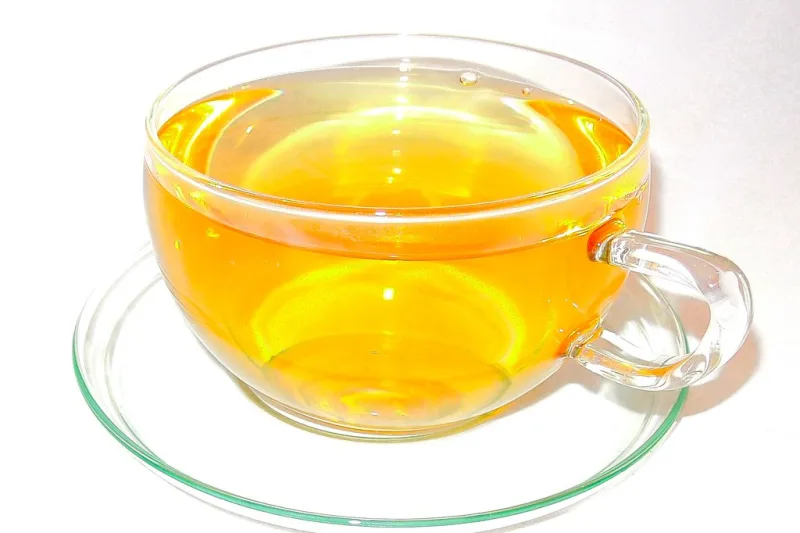

Celandine Tea: Benefits, How to Prepare and Side Effects
IMPORTANT: Greater celandine (Chelidonium majus) is a powerful plant with a narrow safety margin. It contains alkaloids that, in large amounts or in prolonged courses, can damage the liver — the very organ people hope to support. Celandine tea must NOT be drunk daily for months on end, and must NOT be given to children, to pregnant or breastfeeding women, to people with active liver disease, hepatitis or cirrhosis, or to anyone taking medication processed by the liver. The fresh orange-yellow latex is irritating and is never swallowed as such. Before any internal course of celandine, talk to your doctor or an experienced herbalist. This article is for information only and does not replace medical advice.
Grandmother Veta, from the villages below the mountains, had a corner of her garden she never weeded. There, beside the shady plank fence, a small plant grew freely, with tiny yellow flowers and a stem that, when broken, oozed a drop of orange “milk.” “That’s celandine, dear,” she would tell her grandchildren, “and with its yellow juice I painted the warts of half the village.” For the sluggish gallbladder of the old man at the top of the lane, however, she made something else: a faintly bitter, weak tea from a knife-tip of dried plant, which she gave only for a few days, “just enough to get the bile moving,” never more. Grandmother Veta had something many of today’s enthusiasts lack: respect for the plant’s power. She knew celandine was a remedy, not an everyday drink.
That respect is the thread running through this whole article. Celandine tea has a long tradition in Romanian and European folk medicine, especially for complaints of the bile and liver, but it is, of all the teas described on this site, one of the few that demands the most caution. We will look together at where the plant comes from, what it contains, what it was used for, how to brew a weak tea correctly and, above all, where to draw the red line we must never cross.
What Celandine Is
Greater celandine (Chelidonium majus), known in folk tradition by names such as swallow-wort or wart-weed, is a perennial herbaceous plant from the poppy family (Papaveraceae). It grows throughout Europe, including all of Romania, in damp, shaded places: at the edge of woods, along fences and old walls, in abandoned yards and on uncultivated ground. It reaches 30–80 cm in height, has soft, blue-green pinnate leaves, and small yellow flowers with four petals that appear from spring until autumn.
Its distinguishing sign, recognized by any forager, is the latex: if you break the stem or leaf, a sticky, orange-yellow sap immediately seeps from the wound. This “milk” is both the storehouse of the plant’s most powerful compounds and the source of its toxicity. The Latin name comes from the Greek chelidon, meaning swallow — old writers believed the plant bloomed when swallows arrived and faded when they left.
In traditional medicine, celandine had two major uses: externally, the fresh latex on warts and certain skin problems, and internally, as a very dilute tea or tincture to stimulate the bile and support the liver. It is the internal tea — the most delicate use — that we discuss below.
Table of Contents
- What Celandine Is
- Composition and Active Principles
- Traditional Benefits of Celandine Tea
- How to Brew Celandine Tea Correctly
- Dosage and Length of the Course
- External Uses of Celandine
- Combinations with Other Plants
- A Lifestyle for Healthy Bile and Liver
- Practical Tips and Common Mistakes
- Conclusion
- Frequently Asked Questions
Composition and Active Principles
All of celandine’s power — and all of its danger — comes from its richness in isoquinoline alkaloids, the same class of compounds that includes the active substances of the poppy. Among the most important are:
- Chelidonine — the main alkaloid, with an antispasmodic effect on smooth muscle, meaning it relaxes spasms in the area of the bile ducts and the digestive tract.
- Coptisine, berberine, sanguinarine, chelerythrine — alkaloids with varied actions, from stimulating bile secretion to antimicrobial effects; sanguinarine and chelerythrine are also the most irritating.
- Organic acids (chelidonic, citric, malic), flavonoids and saponins, which round out the plant’s profile.
The alkaloid concentration varies enormously depending on the time of harvest, the part of the plant, and the way it is dried. This very variability is what makes celandine hard to dose, and it explains why tradition recommends very weak teas and short courses. Studies suggest that the bile-stimulating and antispasmodic effects are real, but those same studies warn of the potential for liver toxicity when the plant is consumed in excess — a paradox we must keep firmly in mind.
Traditional Benefits of Celandine Tea
We stress once more: we are talking about traditional, folk uses, not guaranteed treatments. Here is what celandine tea has been valued for over time.
Stimulating the Bile (Choleretic and Cholagogue Effect)
This is celandine’s flagship use. Folk tradition and European herbalism consider it a plant that, on the one hand, stimulates the liver to produce more bile (choleretic effect) and, on the other, helps empty the gallbladder (cholagogue effect). In practical terms, it “gets a lazy bile moving.” Hence its reputation in heavy digestion, especially after fatty meals, in the feeling of fullness under the right ribs, and in that dull discomfort folk tradition calls “the bile that won’t work.”
The Antispasmodic Effect on the Bile Ducts and Digestion
Chelidonine relaxes smooth muscle, which, in practical language, means fewer cramps along the biliary and intestinal pathway. Tradition used weak celandine tea to calm the painful spasms that accompany difficult digestion and to ease biliary flow. It is precisely this effect that explains why, in classic bile blends, celandine appears alongside bitter and carminative plants.
Support for Heavy Digestion
Through the combination of stimulating bile and relaxing spasms, celandine tea has been considered a help for people who “can’t digest fats,” who feel bloated and weighed down after eating. Good bile is essential for breaking down fats, and a gallbladder that works properly eases the whole of digestion.
A Reputation as a “Depurative” Plant
In folk medicine, celandine frequently appears among the “cleansing” plants, used in spring courses to “purify the blood” and support elimination. This reputation owes more to tradition than to modern evidence, but it explains why the plant was so beloved by herbalists of old. It must be said plainly, though: the idea of a “detox” never justifies long courses of a plant that is potentially toxic to the liver.
External Action on Warts
Celandine’s best-known folk use has nothing to do with tea, but with the fresh latex applied to warts, corns and certain skin lesions. The orange-yellow sap, dabbed daily directly onto the wart, is the remedy from which the plant earned its name “wart-weed.” We discuss this below, under external uses.
How to Brew Celandine Tea Correctly
Here the golden rule is a single one: weak and little. Celandine tea is not made “strong so it works better.” On the contrary — the more concentrated it is, the riskier it becomes. Only the dried plant is used, correctly harvested (the flowering aerial part), never the fresh latex-bearing plant for internal use.
Classic Weak Infusion (Basic Recipe)
- Measure a knife-tip to at most half a teaspoon of dried, crumbled celandine (about 1 gram) per 200–250 ml cup. No more.
- Boil the water and let it come off the boil for 1–2 minutes — very hot water, but not a violent boil.
- Pour the water over the plant and cover the cup with a saucer so the volatile oils are not lost.
- Let it steep for 8–10 minutes, no longer.
- Strain very well, through a fine sieve or cheesecloth, so no plant fragments remain.
- Drink the tea lukewarm, never more than one cup a day, preferably shortly before a meal when the goal is to stimulate the bile.
The tea has a faintly bitter, slightly pungent taste. It is not traditionally sweetened, because the bitterness is part of the effect on the bile, but if you find it very hard to drink, half a teaspoon of honey can be added after the tea has cooled a little.
Light Decoction (Variation)
Some old recipes call for a short decoction: the plant is placed in cold water, slowly brought to a boil and allowed to simmer very gently for 2–3 minutes, then strained at once. Here too the quantity remains small, and consumption is limited to one cup.
What NOT to Do When Brewing
- Don’t use “a heaping spoonful to make it stronger.” The dose of plant is small precisely because the alkaloids are powerful.
- Don’t boil the plant for long minutes “like black tea.” A prolonged decoction extracts more alkaloids.
- Don’t use the fresh, latex-bearing plant for tea. The latex is irritating and hard to dose.
- Don’t reuse the plant for a second infusion “to avoid waste.”
Dosage and Length of the Course
If there is one chapter you must not skip, this is it. Celandine is the remedy where duration and quantity matter more than with any other tea.
- Quantity: at most one cup of weak tea per day.
- Length of course: tradition and prudence recommend short courses — usually 7–10 days at most, followed by a long break. Never courses of weeks or months on end.
- Frequency of courses: repeated rarely, not month after month.
- Signs to stop immediately: any persistent nausea, pain at the liver (under the right ribs), yellowing of the skin or the whites of the eyes, dark urine, unusual fatigue — all of these are warning signs that call for stopping at once and seeking medical advice.
The reason for this caution is simple: although celandine was traditionally used for the liver, modern medical literature has described cases of liver injury in people who consumed celandine preparations in large doses or over long periods. In other words, the plant that “helps the liver” can also harm it if used wrongly. That is why the rule is: little, short, rarely — and with your doctor’s agreement if you have any health condition.
External Uses of Celandine
Besides the internal tea, celandine has a famous external use that is much safer for most people, because the substances do not reach the bloodstream in significant amounts.
Latex on Warts
The classic method: break a fresh celandine stem and apply the drop of orange-yellow sap directly onto the wart, carefully avoiding the healthy skin around it. Repeat once or twice a day for several days in a row. Tradition says the wart gradually darkens and falls off. The surrounding skin can be protected with a little petroleum jelly. The latex is not applied to open wounds, to mucous membranes, to the face near the eyes, and is never swallowed.
Compresses and Washes (with Caution)
The weak, cooled tea was also traditionally used for external washes in certain skin problems. Here too it is wise to test on a small patch of skin first, since celandine can irritate.
Combinations with Other Plants
In folk blends for bile and liver, celandine almost never appears alone, but in small amounts, “tempered” by gentler plants that balance its power:
- Artichoke — a classic support for liver and bile, with a far gentler profile.
- Milk thistle (silymarin) — the reference plant for liver protection, a logical partner.
- Dandelion — bitter, mildly choleretic, supports digestion and elimination.
- Peppermint — relaxes spasms and softens the taste of the blend.
- Yarrow — bitter, digestive, complements the action on the bile.
In a blend, celandine should be the minor ingredient, not the base. If you have no experience, the safest course is to buy ready-dosed blends from a pharmacy or herbalist’s shop, with clear directions, rather than blends made “by eye” at home.
A Lifestyle for Healthy Bile and Liver
No tea, however powerful, can make up for a lifestyle that overworks the liver. If the health of your bile matters to you, these habits count for more than any plant:
- Smaller, more regular meals, without heavy feasts late at night. Bile works better with a steady rhythm.
- Quality fats, in moderate amounts — olive oil, nuts, oily fish — instead of fried foods and trans fats.
- Plenty of bitter, green vegetables (artichoke, rocket, dandelion, radishes), which naturally stimulate the bile.
- Good hydration — water helps keep the bile fluid.
- Daily movement, even a walk after a meal, which supports digestion.
- As little alcohol as possible — the liver is the first to pay for excess.
Celandine tea, used correctly and for the short term, can be a small, targeted help within such a healthy context, not a substitute for it.
Practical Tips and Common Mistakes
Mistake no. 1: Treating celandine as an ordinary tea to drink daily. This is the most dangerous confusion. Celandine is not peppermint or linden. It is a plant-medicine, used in small amounts, briefly, and rarely.
Mistake no. 2: Making the tea “more concentrated so it’s more effective.” With celandine, more concentrated means more alkaloids and more risk. The small dose is not a weakness of the recipe — it is its essence.
Mistake no. 3: Swallowing the fresh latex hoping for a “stronger” effect. The latex is irritating and is never taken internally. Only the dried plant, as a weak tea, is used for consumption.
Mistake no. 4: Continuing the course for weeks or months. Long courses are exactly the ones associated with liver problems. Respect the rule: 7–10 days at most, then a long break.
Mistake no. 5: Using it without regard for medication. If you take treatments processed by the liver or have a liver condition, celandine can be dangerous. Ask your doctor’s opinion first.
Mistake no. 6: Giving it to children or drinking it in pregnancy. Celandine is contraindicated for children, pregnant women and those who are breastfeeding. There is no reason that justifies the risk.
Mistake no. 7: Confusing celandine with another plant when foraging. Forage only if you are absolutely sure of the identification. The orange-yellow latex is the distinguishing sign, but if you have the slightest doubt, buy the dried plant from a herbalist’s shop.
Conclusion
Celandine tea is a respected traditional remedy for bile and liver, with choleretic, cholagogue and antispasmodic effects recognized by folk herbalism. Precisely because it is effective, it is also powerful — and that power demands caution. Unlike the gentle teas we can drink daily, celandine is used in small doses, in short and infrequent courses, never by children, pregnant women or people with liver problems. Used wisely, as a weak tea over the short term, it can be a targeted support for heavy digestion and a sluggish gallbladder. Used wrongly, it can harm the very organ we hoped to help. Respect for the plant, a small dose and the advice of a doctor are the three rules that make the difference between a remedy and a problem.
Frequently Asked Questions
Can I drink celandine tea every day? No. Celandine is not a tea for daily consumption. It is used in short courses of 7–10 days at most, one cup a day, followed by long breaks. Daily, prolonged use is associated with the risk of liver damage.
Is it true that celandine helps the liver? Traditionally, yes — it stimulates the bile and supports the digestion of fats. The paradox is that, in excess, the same plant can harm the liver. That is why the rule is: little, short, rare, and with your doctor’s agreement if you have any liver condition.
How do I recognize celandine? It is a plant with small yellow flowers, blue-green pinnate leaves and, above all, an orange-yellow latex that seeps out immediately when you break the stem. That orange “milk” is its distinguishing sign.
Can I use celandine sap on warts? Yes, this is the classic external use. Apply the fresh latex directly onto the wart, avoiding healthy skin, once or twice a day. Do not apply it to open wounds, to the face near the eyes, and never swallow it.
Is celandine tea sweetened? Traditionally no, because the bitterness is part of the effect on the bile. If you find it very hard to drink, you can add a little honey after the tea has cooled somewhat.
Can I take celandine if I’m on medication? Only after asking your doctor. Celandine may interact with medicines processed by the liver and may overburden that organ. Likewise, it is contraindicated in pregnancy, breastfeeding and in children.
What should I do if nausea or pain appears during the course? Stop the tea immediately and consult your doctor, especially if yellowing of the skin or eyes, dark urine or unusual fatigue appears. These can be signs of liver distress.
Which plants does celandine combine with? In small amounts, with gentler plants for liver and bile: artichoke, milk thistle, dandelion, peppermint, yarrow. Celandine should always be the minor ingredient in such a blend.