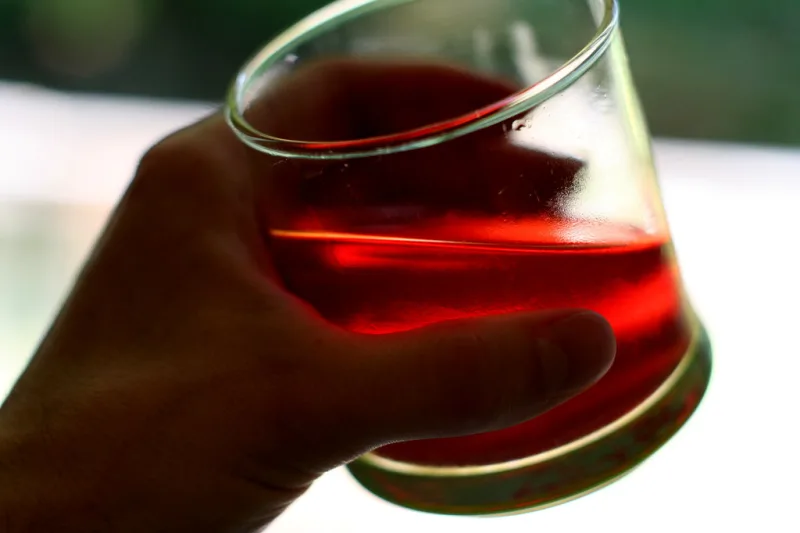

Hibiscus Tea: Benefits, How to Prepare and Side Effects
IMPORTANT: Hibiscus tea can lower blood pressure, which is why people already taking medication for hypertension (especially diuretics or antihypertensives) should talk to their doctor before drinking it regularly — the cumulative effect can push blood pressure down too far. Pregnant or breastfeeding women should avoid hibiscus, since folk tradition and some observations suggest it may influence hormonal balance and the uterus. Hibiscus may also interact with certain medications (for example diabetes drugs or some painkillers) and can reduce the absorption of certain substances, such as paracetamol. If you are on any treatment, have kidney stones, or live with a chronic condition, always seek your doctor’s advice. Hibiscus never replaces prescribed treatment.
Grandmother Veta, from a village in the Trotuș valley, kept a large glass jar on her windowsill every summer, in which she steeped dried red petals brought by a granddaughter returning from Egypt. “This red tea cools you down and washes your blood,” she would say, pouring the ruby liquid over ice cubes and a spoonful of honey. On the scorching days of July, when everyone else complained of dizziness and a heart that “pounded like a hammer,” she calmly sipped from her sour, pomegranate-red glass. She claimed that ever since she started drinking “that flower from across the seas,” her head no longer spun when she stood up.
Later, when a young village doctor heard the story, she smiled and admitted that the grandmother had, without knowing it, a good instinct: that red plant is indeed studied precisely for its effect on blood pressure. And the sour taste, similar to cranberries, was not just a summer pleasure — it was the signature of the acids and pigments that give hibiscus its color and part of its virtues.
Hibiscus tea is made from the dried calyces of the Hibiscus sabdariffa flower, a plant native to the tropical regions of Africa and used today all over the world, from Mexico (where it is called “agua de Jamaica”) to Egypt (where it is known as “karkade”). The calyces are those fleshy, deep-red little leaves that remain after the flower wilts. Dried and infused, they yield a ruby, tart drink full of antioxidants, enjoyed both warm, as a soothing winter tea, and cold, as a refreshing summer lemonade.
Table of Contents
- What hibiscus is and where it comes from
- Composition and active compounds
- Health benefits
- Traditional uses around the world
- How to brew hibiscus tea correctly (step-by-step recipes)
- When and how much to drink
- Combinations with other plants
- Lifestyle and practical tips
- Practical Tips and Common Mistakes
- Conclusion
- Frequently Asked Questions
What hibiscus is and where it comes from
The hibiscus used for tea is not the ornamental flower we grow in pots on the balcony, but a specific species, Hibiscus sabdariffa, popularly known as “roselle” or “Sudanese hibiscus.” It is a short annual or perennial plant with reddish stems that produces yellow flowers with a red center. After flowering, the fleshy, cherry-red calyces remain around the fruit, and these are the most prized part. They are harvested, dried in the sun or in dryers, and reach us as crumbled or whole petals, ready to infuse.
The plant’s origin is in tropical Africa, from where it spread over the centuries to Asia, the Caribbean, and Central America. It thrives in warm, humid climates, which is why the main producers remain Egypt, Sudan, Mexico, Thailand, and China. In our cooler regions, drinking hibiscus does not grow well in open fields because of the cold winters, but the dried petals are easy to find in health-food stores and in fruit-tea blends — hibiscus is often the very component that gives many “forest” or “hibiscus and rosehip” teas their red color and tart taste.
Over time, people have valued hibiscus not only for its taste and color, but also for the sense of freshness it provides. In hot countries it is drunk as an everyday refreshment, and in traditional medicine it has been used to “cool” the body, aid digestion, and support the heart.
Composition and active compounds
The spectacular color and tart taste of hibiscus are no accident — they reveal a composition rich in active substances.
The most important are the anthocyanins, pigments from the flavonoid family that give the red-purple color. These are powerful antioxidants, the same class of compounds that color blueberries, blackcurrants, and red grapes. Studies suggest that anthocyanins help neutralize free radicals, the unstable molecules involved in cellular aging.
The sour taste comes from organic acids, especially citric acid, malic acid, and hibiscic acid. These contribute to the sense of freshness and may support digestion.
Hibiscus also contains various polyphenols and flavonoids, along with modest amounts of vitamin C and minerals such as potassium. It also contains mucilage — soluble fibers that give the infusion a slightly velvety texture and which are traditionally considered gentle on the stomach and intestines.
Worth remembering: hibiscus tea contains no caffeine. Unlike black or green tea (which come from the Camellia sinensis plant), hibiscus is a herbal infusion, so it can be drunk in the evening without fear of insomnia.
Health benefits
Supporting blood pressure
The best-known and most-studied benefit of hibiscus is its effect on blood pressure. Studies suggest that regular consumption of hibiscus tea may help maintain healthy blood pressure, especially in people with slightly elevated readings. It is thought that anthocyanins and other polyphenols help keep blood vessels supple and may have a mild diuretic effect that reduces the volume of fluid in circulation.
This effect, though gentle, is real, which is precisely why people already taking blood-pressure medication should be cautious: the combination may lower pressure too much. For healthy people, however, a glass or two a day can be a pleasant support for a balanced lifestyle.
A wealth of antioxidants
The abundance of anthocyanins and polyphenols makes hibiscus one of the most “colorful” sources of antioxidants in the plant kingdom. Antioxidants help the body cope with oxidative stress, a process involved in aging and in many chronic imbalances. Folk tradition holds that intensely red drinks “cleanse” and “revive,” and modern science at least partly confirms that an intake of polyphenols is beneficial.
Support for digestion
Thanks to its organic acids and mucilage, hibiscus has traditionally been used to stimulate appetite and ease digestion after heavy meals. The sour taste triggers salivation and digestive secretions, and the sense of freshness helps combat that heavy, full feeling. In many cultures, a glass of cold “agua de Jamaica” accompanies hearty meals for precisely this reason.
Hydration and refreshment
Drunk cold, hibiscus is an excellent alternative to sweetened fizzy drinks. It has taste and color, but no sugar (unless you add it) and no caffeine. In hot regions people drink it by the liter, as a daily refreshment, precisely because it hydrates pleasantly and satisfies the craving for something tart and colorful.
Supporting fat metabolism
Studies suggest that the polyphenols in hibiscus may play a role in how the body manages blood fats. Folk tradition in the regions where it is frequently consumed considers it a “light” drink, suitable within a balanced diet. It is not a weight-loss remedy, but it fits well into a healthy regimen, especially when it replaces sugary drinks.
Comfort in the cold season
Warm, with a spoonful of honey and a slice of lemon, hibiscus becomes a soothing winter tea. Its vitamin C and sense of freshness make it a pleasant companion on cold days, when you need something warm and colorful to revive you.
Traditional uses around the world
Hibiscus has a rich history in many corners of the world. In Egypt and Sudan, “karkade” is a national drink, served both hot and cold at weddings and celebrations. In Mexico, “agua de Jamaica” is one of the most popular “aguas frescas,” refreshing drinks sold on every street corner. In the Caribbean, hibiscus (called “sorrel”) is a must at the Christmas table, prepared with ginger and spices. In Southeast Asia, the calyces are also used in jams and syrups.
Beyond the drink, the dried petals go into fruit-tea blends, syrups, tart jams, and even desserts, where they provide a spectacular natural color. In our region, hibiscus has entered mainly through fruit teas, being the ingredient that provides that bright red and tart taste many associate with “forest tea.”
How to brew hibiscus tea correctly (step-by-step recipes)
Hibiscus is one of the most forgiving plants to infuse — it is hard to get it wrong. Still, a few details make the difference between a pale tea and a ruby one bursting with flavor.
The classic hot infusion
You will need:
- 1–2 teaspoons of dried hibiscus petals (about 1.5–2 g)
- 250 ml of hot water (near boiling, but not violently boiling)
- optional: honey, lemon, cinnamon
Steps:
- Place the hibiscus petals in a cup or teapot.
- Pour the hot water over them.
- Cover the cup and let it steep for 5–10 minutes. The longer you infuse, the redder and more tart the tea becomes.
- Strain the petals.
- Sweeten if you like with honey (added after the tea has cooled a little, so as not to destroy the enzymes in the honey) and add a slice of lemon.
The taste is tart and refreshing, similar to cranberries or currants. If it seems too sour, reduce the steeping time or the amount of petals.
Cold tea (cold infusion)
This is the preferred method for summer, because it gives a milder, clearer taste.
You will need:
- 2 tablespoons of dried petals
- 1 liter of cold water
- optional: honey, lemon slices, mint leaves
Steps:
- Place the petals in a carafe of cold water.
- Leave in the fridge for 6–12 hours (overnight is ideal).
- Strain, sweeten to taste, and serve with ice and mint.
The cold infusion extracts less acid and more delicate pigments, yielding a ruby, refreshing, less astringent drink.
Concentrated decoction (for syrup or strong drinking)
If you want very intense color and flavor, you can make a decoction:
- Place 3 tablespoons of petals in 500 ml of water.
- Bring to a boil, then reduce the heat and let it simmer gently for 10 minutes.
- Strain. You can add honey or sugar to obtain a syrup that you then dilute with still or sparkling water.
The spiced version (Caribbean style)
For a fragrant winter tea, add a slice of fresh ginger, a cinnamon stick, and a few cloves to the hot infusion. Let it steep for 10 minutes. The result is a warm, spicy-tart tea, perfect for cold evenings.
When and how much to drink
For a healthy person, 1–2 cups (250–500 ml) a day is a reasonable and pleasant amount. Because it contains no caffeine, hibiscus can also be drunk in the evening. Many prefer a cup in the morning, as a refreshing alternative to coffee, and one in the afternoon.
If you drink it to support blood pressure, regularity matters more than quantity: one cup a day, drunk consistently, is preferable to a liter drunk all at once. Don’t overdo it — more does not mean better, and very high consumption can lower blood pressure or irritate the stomach in sensitive people because of the acidity.
It is best drunk between meals or after meals (for digestion), not on an empty stomach if you suffer from gastric acidity.
Combinations with other plants
Hibiscus pairs wonderfully with other plants and fruits:
- Hibiscus and rosehip: the classic fruit-tea combination, rich in vitamin C and tart.
- Hibiscus and mint: refreshing par excellence, especially drunk cold in summer.
- Hibiscus and ginger: spicy and invigorating, good for digestion and the cold season.
- Hibiscus and cinnamon: sweet-tart, fragrant, perfect for winter.
- Hibiscus and berries: for a spectacular natural lemonade.
Because hibiscus has a strong taste, it can dominate blends, so use it sparingly when combining it with delicate plants.
Lifestyle and practical tips
Hibiscus tea fits best into a lifestyle where it replaces sugary and fizzy drinks. If you have the habit of drinking juice or carbonated drinks with meals, a carafe of cold hibiscus, unsweetened or lightly sweetened with honey, is a much healthier alternative — with taste and color, but without the refined sugar.
Prepare a carafe in the evening and keep it in the fridge — you will always have a refreshing drink on hand. In summer, add slices of lemon, orange, or a few mint leaves for extra freshness. In winter, turn it into a warm spiced tea.
Buy quality hibiscus from trusted sources, preferably whole or large petals of an intense red. Faded or overly crumbled petals often have less flavor. Store them in an airtight jar, in a dark, dry place, away from humidity and strong odors — dried petals keep their aroma for months if stored correctly.
Practical Tips and Common Mistakes
Mistake no. 1: Using water that is too hot and at a violent boil. Vigorously boiling water can make the tea more astringent and bitter. Use hot water, but let it sit for a few seconds after it has boiled.
Mistake no. 2: Over-steeping. If you leave the petals too long, the tea becomes excessively sour. For a balanced taste, 5–7 minutes hot is enough; adjust to preference.
Mistake no. 3: Over-sweetening. Many pour in a lot of sugar to mask the acidity, turning a healthy drink into a calorie-laden one. Use honey sparingly, or gradually train your palate to enjoy the natural acidity.
Mistake no. 4: Drinking it on an empty stomach if you have acidity. Hibiscus is acidic; if you have a sensitive stomach, drink it after a meal, not in the morning before eating.
Mistake no. 5: Ignoring drug interactions. If you take medication for blood pressure or diabetes, don’t assume a “natural” tea is automatically harmless. Talk to your doctor.
Mistake no. 6: Storing the petals in open bags or in dampness. They quickly lose their color and aroma. Use an airtight jar.
Mistake no. 7: Discarding the petals after the first infusion when you want intense color — for a concentrated tea, use a larger amount from the start, rather than re-infusing already-spent petals.
Conclusion
Hibiscus tea is one of the most accessible and enjoyable infusions you can add to your routine. With its spectacular ruby color and its refreshing, tart taste, it is both a delight for the senses and a gentle support for health — especially for supporting blood pressure and for its rich antioxidant content. The absence of caffeine makes it suitable at any hour, and its versatility (hot or cold, plain or spiced) recommends it in any season.
Like any of nature’s remedies, hibiscus works no miracles on its own, but drunk in moderation and consistently, within a balanced lifestyle, it can be a pleasant ally. Just keep the precautions in mind: consult your doctor if you take blood-pressure medication, avoid it during pregnancy and breastfeeding, and listen to your stomach if you are sensitive to acidity. Otherwise, enjoy your glass as red as a pomegranate, just as grandmother Veta did during the scorching summers.
Frequently Asked Questions
Does hibiscus tea really lower blood pressure? Studies suggest that regular consumption may help maintain healthy blood pressure, especially in people with slightly elevated readings. The effect is gentle but real, which is why those already taking blood-pressure medication should be cautious and consult their doctor.
Does it contain caffeine? No. Hibiscus is a herbal infusion, not a true tea from Camellia sinensis, so it contains no caffeine and can be drunk in the evening without affecting sleep.
Can I drink hibiscus tea every day? Yes, a healthy person can drink 1–2 cups a day without problems. Avoid very large amounts and listen to your body, especially if you have a sensitive stomach or low blood pressure.
Is it safe during pregnancy? It is not recommended. Folk tradition and some observations suggest that hibiscus may influence hormonal balance and the uterus, so pregnant or breastfeeding women should avoid it and seek their doctor’s advice.
Why is my hibiscus tea too sour? You probably steeped it too long or used too many petals. Reduce the steeping time to 5 minutes and the amount to one teaspoon per cup. A cold infusion gives a milder taste.
Hot or cold — which is better? It depends on the season and your preference. Hot, with honey and lemon, it is soothing in winter. Cold, with ice and mint, it is an excellent summer refreshment. The cold infusion has a finer, less astringent taste.
Can I use the ornamental hibiscus from my pot? No. The tea is made from the Hibiscus sabdariffa species (roselle), not from ornamental houseplant hibiscus. Buy dried petals intended for consumption, from trusted sources.
How do I store hibiscus petals? In an airtight jar, in a dark, dry place, away from humidity and strong odors. This way they keep their color and aroma for many months.