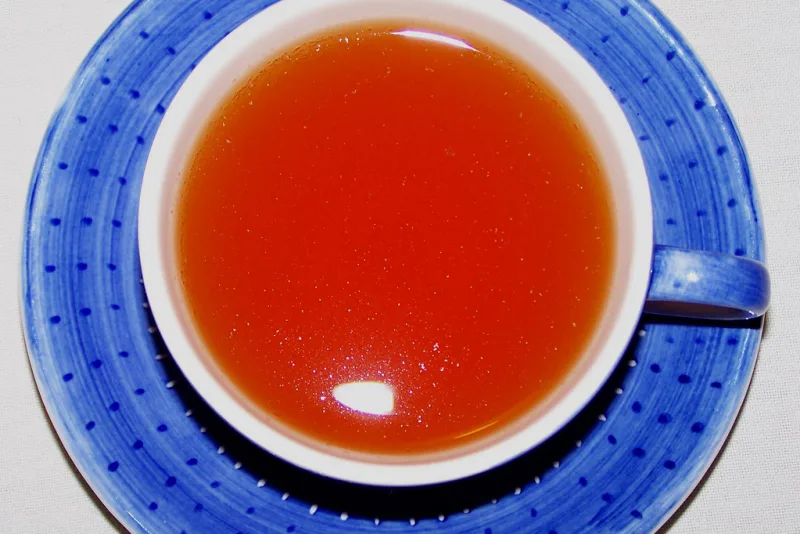

Rooibos Tea: Benefits, How to Prepare and Side Effects
IMPORTANT: Rooibos tea is generally extremely well tolerated and is one of the few teas considered safe even for young children and pregnant women, precisely because it contains no caffeine. Nevertheless, if you are on medication (especially for liver conditions, hormone-sensitive cancers, or drugs metabolized by the liver), if you drink very large amounts daily, or if you have a chronic condition, it is wise to talk to your doctor before making it a daily beverage. Rooibos never replaces a prescribed treatment or a medical consultation.
Aunt Sanda, a woman I met at an herb market in a small Transylvanian town, always kept a large jar on her kitchen table, filled with reddish-brick strands that many people mistook for some kind of tobacco. “It’s my evening tea,” she would say with a laugh, “ever since the doctor banned coffee and black tea for me in the afternoons. I drink a cup of this red brew and sleep like a baby.” She had learned about rooibos from a granddaughter who had moved to South Africa and sent her the first packet. From then on she never gave it up — she drinks it plain, with a slice of lemon, or in winter with a little honey and cinnamon.
Her story is far from unique. More and more people have discovered this red tea from far away in recent years, drawn especially by the fact that it contains no caffeine and has a sweetish, gentle flavor, without the bitterness typical of black teas left to steep too long. Rooibos has slowly become a natural alternative to the evening coffee and a support for anyone who wants to hydrate with a warm drink without disturbing their sleep.
Rooibos tea is made from the leaves and fine branches of a shrub called Aspalathus linearis, which grows exclusively in a mountainous region of South Africa called the Cederberg, north of Cape Town. The name “rooibos” comes from Afrikaans and literally means “red bush,” because of the color the leaves take on during fermentation. The indigenous Khoisan peoples have harvested and prepared it for centuries, and today it has become one of the most appreciated caffeine-free drinks in the world. Unlike green or black tea, which come from the Camellia sinensis plant, rooibos is an entirely different plant, from the legume family, which is why both its chemical and flavor profiles are unique.
Table of Contents
- What rooibos tea is and where it comes from
- Composition and active compounds
- Health benefits
- Red rooibos vs. green rooibos
- How to brew rooibos tea correctly
- When and how much to drink
- Combinations with other plants and ingredients
- Rooibos for children and pregnant women
- Lifestyle and practical tips
- Practical Tips and Common Mistakes
- Conclusion
- Frequently Asked Questions
What rooibos tea is and where it comes from
Rooibos is an infusion prepared from the Aspalathus linearis shrub, a woody plant with thin, needle-like leaves that grows only in the sandy, poor soil of the Cederberg mountains. This region has a particular climate — very dry, hot summers and cold, rainy winters — and the plant has adapted perfectly to these conditions, developing a deep root system that allows it to draw water and minerals from below. It is precisely these extreme conditions and the specific soil that mean authentic rooibos cannot be successfully grown elsewhere in the world.
Harvesting takes place in summer, when the young branches are cut, finely chopped, and then, in the case of red rooibos, left to ferment. During fermentation — which is in fact a process of enzymatic oxidation, similar to that of black tea — the green leaves change color, turning reddish-brick, and develop that sweetish, slightly woody and caramelized taste that makes them so pleasant. After oxidation, the material is dried in the sun.
The history of rooibos consumption goes back a long way. The Khoisan tribes of the region gathered it from the mountain slopes, cut it with small axes, left it to ferment, and then prepared it as a drink. Toward the start of the 20th century, rooibos began to be marketed and valued as an affordable substitute for the then-expensive imported black tea. Today it is protected as a designation of origin and is a South African national pride, exported to dozens of countries.
Composition and active compounds
What makes rooibos truly special from a health perspective is its rich profile of antioxidant compounds, combined with the total absence of caffeine and a very low tannin content.
Polyphenols and flavonoids. Rooibos contains a wide range of antioxidants, two of which are especially important and relatively rare in the plant world: aspalathin and nothofagin. Aspalathin in particular is almost unique to rooibos and is intensely studied for its properties. In addition, the tea also contains quercetin, rutin, orientin, isoorientin, luteolin, and chrysoeriol — all known for their ability to neutralize free radicals.
No caffeine. Unlike green tea, black tea, or coffee, rooibos contains no caffeine at all. This makes it suitable for drinking at any hour, including the evening, and for people sensitive to stimulants — those with palpitations, anxiety, insomnia, or hypertension aggravated by caffeine.
Low tannin content. Tannins are the compounds that give black tea its astringent taste and which, in large amounts, can interfere with iron absorption. Rooibos contains far fewer tannins, which means it can also be drunk by people with anemia or those who want to maximize iron absorption from food.
Minerals. The infusion brings small amounts of minerals such as potassium, calcium, magnesium, manganese, zinc, and fluoride. Although it is not a major source of minerals, it contributes to overall intake when consumed regularly.
Studies suggest that it is precisely the combination of aspalathin, the other polyphenols, and the lack of caffeine that explains a good part of the benefits traditionally observed in rooibos drinkers.
Health benefits
Antioxidant support and cellular protection
The best-documented benefit of rooibos is its antioxidant capacity. Free radicals are unstable molecules that form naturally in the body, but also under the influence of pollution, smoking, stress, or UV radiation. In excess, they cause what is known as oxidative stress, associated with premature aging and numerous chronic conditions. The polyphenols in rooibos, especially aspalathin, help neutralize these free radicals. Folk tradition and observations of regular drinkers suggest that a cup or two a day may contribute to supporting general cellular protection.
A heart-friendly drink
Rooibos is traditionally valued for the support it offers the cardiovascular system. Studies suggest that its antioxidants may help maintain the elasticity of blood vessels and support a healthy cholesterol balance. For those who, like Aunt Sanda, have given up caffeine due to blood pressure or palpitations, rooibos offers a warm and soothing alternative, without the stimulant effect of caffeine on the heart.
Supporting blood sugar balance
One of rooibos’s most promising compounds, aspalathin, is being studied for its effect on sugar metabolism. Preliminary research suggests it could help maintain a balanced blood sugar level. For people watching their sugar intake, rooibos has the advantage of being naturally sweetish, which means it can be drunk without added sugar or honey, satisfying a sweet craving in a gentle way.
Digestive support and a calmer stomach
In traditional South African medicine, rooibos was often used to soothe digestive problems, including colic in infants. Its mild antispasmodic properties may help relax the muscles of the digestive tract, easing discomfort, bloating, and mild cramps. A warm cup of rooibos after a meal is a pleasant and soothing habit for the stomach.
Help for restful sleep
Because it contains no caffeine, rooibos is the ideal evening drink. Many consumers, exactly like the woman in the opening story, say that a warm cup before bed helps them relax and fall asleep more easily. The ritual itself — the warmth, the sweetish taste, the aroma — has a calming effect, and the absence of stimulants means sleep is not disturbed.
Benefits for the skin
Rooibos is also used externally, in compresses or as a toner, for irritated, reddened, or breakout-prone skin. The naturally present antioxidants and alpha-hydroxy acids may help calm minor skin inflammation. A cool rooibos compress applied to tired eyes or irritated areas is a gentle, accessible traditional cosmetic remedy.
Hydration without side effects
Being a caffeine-free drink with no strong diuretic effect, rooibos contributes to daily hydration without causing fluid loss. For anyone bored with plain water but wanting to stay hydrated, rooibos (hot or cold, as iced tea) is an excellent option.
Red rooibos vs. green rooibos
Many people don’t know there are two types of rooibos. Red rooibos is the classic, fermented (oxidized) one, with the sweetish, woody taste and the well-known brick color. Green rooibos, on the other hand, does not go through the fermentation process; the leaves are dried immediately after harvesting, keeping their greenish color and a more herbaceous, fresher taste, somewhat similar to green tea but still caffeine-free.
The difference is not only in taste. Green, unoxidized rooibos retains a larger amount of aspalathin and other antioxidants, since oxidation partially destroys these compounds. For this reason, green rooibos is sometimes preferred by those who are primarily after the antioxidant effect. Red rooibos, in turn, is more aromatic, sweeter, and more affordable, and is also the most widespread. Both varieties are valuable; the choice comes down to personal preference.
How to brew rooibos tea correctly
One of rooibos’s great advantages is that it is almost impossible to “ruin.” Unlike green or black tea, which turn bitter if the water is too hot or if you steep it too long, rooibos stays pleasant no matter how long you let it steep.
The classic recipe (in a cup)
Ingredients needed:
- 1 heaping teaspoon (about 2–3 g) of loose rooibos, or one tea bag
- 200–250 ml of water
Preparation steps:
- Boil the water to a full boil (100 °C / 212 °F). Unlike green tea, rooibos handles maximum-temperature water very well.
- Put the rooibos in a cup or infuser and pour the hot water over it.
- Cover the cup and let it steep for 5–10 minutes. The longer you steep it, the more intense and richer the flavor becomes — without turning bitter.
- Strain (if you used loose tea) and enjoy plain or with additions.
The teapot recipe (for several servings)
For a family or a larger serving, use one tablespoon of rooibos per every 200 ml of water. Let it steep for 7–10 minutes, then strain. Rooibos can be re-steeped once or twice, although the second infusion will be weaker.
Iced rooibos
In summer, prepare a stronger infusion (2 teaspoons per 200 ml), let it cool, then refrigerate and serve over ice with lemon slices, mint leaves, or a few berries. It is an excellent refreshing drink, caffeine-free and with no added sugar.
Rooibos latte
For a creamy treat, prepare a concentrated rooibos and combine it with warm, frothed milk (dairy or plant-based) plus a touch of vanilla or cinnamon. It’s a warm and soothing alternative to an evening latte.
When and how much to drink
The beauty of rooibos is that it can be drunk at any time of day or night, with no fear of disrupting your sleep. For a balanced and pleasant intake, 2–3 cups a day is a reasonable and safe amount for most people.
- In the morning: a warm cup, as a gentle alternative to coffee, for those who want to cut back on caffeine.
- After meals: for digestive support and to soothe the stomach.
- In the evening: the classic relaxation cup, before bed, with no risk of staying awake.
There is no strict “therapeutic” dose, since rooibos is a drink, not a medicine. The key is regularity and moderation — just as with any healthy beverage.
Combinations with other plants and ingredients
Rooibos has a mild taste that blends beautifully with many other flavors and herbs:
- With cinnamon and a slice of orange — for a warm, fragrant autumn-winter drink.
- With mint — for a refreshing version, excellent cold in summer.
- With vanilla and honey — for a dessert-like, sweet and soothing taste.
- With ginger and lemon — for the cold season, as immune support and for a warming sensation.
- With milk and a touch of cardamom — for a kind of caffeine-free “chai.”
Many commercial blends combine rooibos with flower petals, fruit pieces, or caramel, turning it into a gourmet drink.
Rooibos for children and pregnant women
One of the most prized attributes of rooibos is its safety. Because it contains no caffeine and has very few tannins, it is traditionally considered one of the few warm drinks suitable even for young children. In South Africa, diluted rooibos is even traditionally used to soothe colic in infants. Still, for babies and very young children, it is essential to talk to a pediatrician first.
For pregnant or breastfeeding women too, rooibos is generally considered a safer choice than caffeinated teas. The absence of stimulants and of excess tannins are advantages. Even so, during pregnancy and breastfeeding, caution calls for consulting your doctor before regularly drinking any herbal tea.
Lifestyle and practical tips
Integrating rooibos into your daily routine is simple and brings a small ritual of calm. Replacing the afternoon or evening coffee with a cup of rooibos is one of the easiest changes you can make for better sleep. Many people discover that the simple act of brewing a warm, caffeine-free cup gives them a welcome pause in a busy day.
Store loose rooibos in an airtight container, away from light, moisture, and strong odors. This way it keeps its aroma for months. Choose, as far as possible, quality rooibos, preferably with a South African designation of origin, to enjoy the authentic taste and the full antioxidant profile.
Rooibos fits perfectly into a balanced lifestyle: good hydration, a varied diet rich in vegetables and fruit, regular movement, and quality sleep. Drunk in the evening, it can become a signal to the body that the day is ending and that it is time to rest.
Practical Tips and Common Mistakes
Mistake no. 1: Using water that is too cool. Unlike green tea, rooibos needs boiling water (100 °C) to fully release its aroma and antioxidants. Lukewarm water will give a weak, tasteless infusion.
Mistake no. 2: Steeping for too short a time. Many people remove the bag after a minute, as with black tea. Rooibos needs at least 5 minutes, ideally 7–10, to develop its rich flavor. Don’t worry that it will turn bitter — it won’t.
Mistake no. 3: Adding sugar out of habit. Rooibos is naturally sweetish. Taste it plain first — you’ll often find it needs no sweetener at all.
Mistake no. 4: Confusing it with black or Chinese “red” tea. Rooibos is neither black tea nor Chinese “red tea” (pu-erh). It is a completely different plant, caffeine-free. Read the label if you want authentic Aspalathus linearis.
Mistake no. 5: Improper storage. Left in an open bag, exposed to light and moisture, rooibos loses its aroma. Transfer it to an airtight, opaque jar.
Mistake no. 6: Expecting therapeutic “miracles.” Rooibos is a healthy and pleasant drink, not a medicine. Its benefits come from regular consumption within a balanced lifestyle, not from a single “miraculous” cup.
Conclusion
Rooibos tea is one of the friendliest and most versatile drinks you can adopt. Caffeine-free, low in tannins, rich in rare antioxidants such as aspalathin, and naturally sweetish in taste, it suits almost everyone — from children to the elderly, from people sensitive to caffeine to pregnant women (with their doctor’s approval). Whether you drink it in the morning instead of coffee, after a meal for digestion, or in the evening for relaxation, rooibos brings a small ritual of calm and a gentle support for health. As Aunt Sanda used to say, sometimes a simple cup of red tea is all you need to end the day in peace.
Frequently Asked Questions
Does rooibos tea contain caffeine? No, none at all. Rooibos is naturally caffeine-free, which makes it perfect for drinking at any hour, including the evening, and for people sensitive to stimulants.
How much rooibos tea can I drink per day? For most adults, 2–3 cups a day is a safe and pleasant amount. Being a drink rather than a medicine, there is no strict limit, but moderation is always recommended.
Can I drink rooibos in the evening before bed? Yes, it is actually one of the best choices for the evening, precisely because it contains no caffeine. Many drinkers say it helps them relax and fall asleep more easily.
Can children drink rooibos tea? Generally yes — being caffeine-free and low in tannins, it is traditionally considered safe for children. However, for infants and very young children, it is recommended to consult a pediatrician first.
What is the difference between red and green rooibos? Red rooibos is fermented (oxidized), with a sweetish taste and brick color. Green rooibos is not fermented, has a fresher, more herbaceous taste, and retains more antioxidants, especially aspalathin.
Does rooibos help with weight loss? Rooibos is not a “weight-loss drink” in itself, but being calorie-free (when drunk unsweetened) and naturally sweetish, it can replace sugary drinks and satisfy sweet cravings, thereby indirectly supporting a balanced diet.
Can I be allergic to rooibos? Allergic reactions to rooibos are extremely rare. Still, as with any food or plant, if you notice any unusual reaction, stop drinking it and consult your doctor.
Does rooibos interact with medications? In general, rooibos is safe, but if you are being treated for liver conditions or hormone-sensitive cancers, or take drugs metabolized by the liver, it is prudent to talk to your doctor, especially if you consume it in large amounts daily.