
St. John’s Wort Tea: Benefits, How to Prepare and Side Effects
IMPORTANT: St. John’s Wort is one of the most studied medicinal plants, but also one of the most “temperamental” when it comes to interactions. It can reduce the effectiveness of many medications: oral contraceptives, blood thinners (warfarin), prescription antidepressants (especially serotonin reuptake inhibitors), immunosuppressants, HIV medications, some chemotherapy drugs and antiarrhythmics. Combining St. John’s Wort with antidepressants can trigger a dangerous “serotonin syndrome.” The plant also increases the skin’s sensitivity to sunlight (photosensitization). Do NOT drink St. John’s Wort tea if you are pregnant or breastfeeding, if you take any of the medications above, or if you are about to have surgery. Before starting a course, consult your doctor or pharmacist, especially if you are on long-term medication.
A story from the old folk
Grandma Veta, from the hills near Sibiu, had a corner of her garden that no one was allowed to tread on: there, year after year, grew the yellow bushes of St. John’s Wort, “pojarnița” as she called it. Toward the end of June, when the flowers opened all at once and lit up the edge of the garden like fallen stars, she would go out early in the morning, while the dew still clung to the grass, and snip the flowering tops with her scissors. “It’s gathered around Midsummer, when the flower has the most power,” she would say, tying the little bundles with hemp thread and hanging them upside down from the beam in the entryway.
In winter, when someone in the village felt “heavy-hearted” or couldn’t sleep from worry, Grandma Veta would take a jar of dried flowers down from the attic and put the kettle on. She said St. John’s Wort “brings the sun back into a person” during the short, gloomy days of winter. Only much later, reading about plants, did I realize how close to the truth that simple wisdom was: folk tradition used St. John’s Wort for exactly what modern studies suggest today — to support a balanced mood.
What is St. John’s Wort
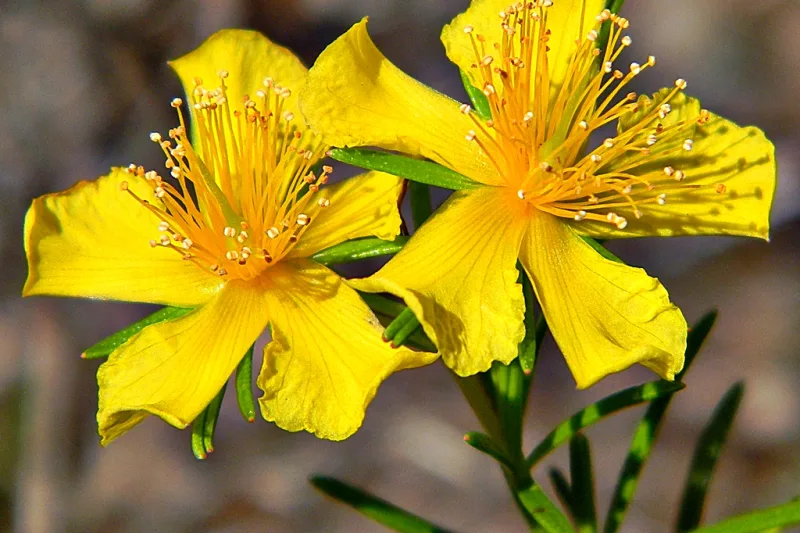
St. John’s Wort (scientific name Hypericum perforatum) is a perennial herbaceous plant of the Hypericaceae family, found throughout Europe, including the hills, meadows and roadsides of Romania. It grows between 30 and 80 centimeters tall, with branched stems, small oval leaves, and bright yellow five-petalled flowers with many fine stamens that give them the look of a solar “burst.”
The English name refers to the feast of St. John the Baptist (June 24), close to the time when the plant blooms. “Perforatum” in its Latin name refers to the leaves: if you hold a leaf up to the light, you see translucent dots, like tiny holes — these are actually small glands containing oils and active compounds. If you rub a fresh flower between your fingers, they take on a wine-red color: this is the pigment hypericin, one of the plant’s most important compounds.
Traditionally, St. John’s Wort is one of the most prized healing plants of the Carpathian region. It is gathered around the Midsummer celebration (June 24), when the plant is in full bloom and is believed to hold its greatest “power.” The flowering tops are dried in the shade, in a thin layer, away from direct sun, and stored in jars or paper bags.
Table of Contents
- Composition and active compounds
- Benefits of St. John’s Wort tea
- How to prepare St. John’s Wort tea correctly
- When and how much to drink
- Combinations with other herbs
- St. John’s Wort externally: the red oil
- How to recognize and harvest St. John’s Wort
- Practical tips and common mistakes
- Precautions and contraindications
- Conclusion
- Frequently Asked Questions
Composition and active compounds
The strength of St. John’s Wort lies in its rich array of bioactive compounds, which work together. Studies suggest that the plant’s effects are not due to a single substance but to a synergistic whole. Here are the main groups of active compounds:
- Hypericin and pseudohypericin — red pigments long considered the plant’s “star” compounds. They are also responsible for the skin photosensitization effect.
- Hyperforin — an aromatic compound to which modern research attributes an important role in the effects on mood. It is sensitive to light and heat, which is why the brewing method matters.
- Flavonoids (rutoside, hyperoside, quercetin, isoquercitrin) — antioxidants that support blood vessels and have a mild calming effect.
- Tannins — which explain the slightly astringent effect, useful externally and for mild digestive issues.
- Volatile oils — which give the tea its characteristic aroma.
- Phenolic acids (chlorogenic acid, caffeic acid) — with an antioxidant role.
This combination makes St. John’s Wort a “many-sided” plant: that is why tradition used it for the spirit as well as for the skin, digestion or wounds.
Benefits of St. John’s Wort tea
Support for a balanced mood
St. John’s Wort’s best-known benefit is linked to mood. Folk tradition called it the “plant of joy” or the “sun plant,” and modern studies suggest that St. John’s Wort extracts can support a balanced mood in cases of mild to moderate low spirits and seasonal melancholy — that heaviness that comes with the short days of autumn and winter. The tea is a gentle form, less concentrated than standardized extracts, but it can be a pleasant support within a self-care routine.
Calm and better sleep
Grandmothers used St. John’s Wort tea in the evening, to “untie the knot in the chest” after a hard day. The mild calming effect of the flavonoids can help with relaxation before bed and with more restful sleep, especially when restlessness or racing thoughts stand in the way of falling asleep. Many people combine it with a little lemon balm or lavender for a more pronounced relaxing effect.
Support for digestion
Thanks to its tannins and volatile oils, St. John’s Wort tea has a mild tonic and astringent effect on the digestive tract. Tradition recommended it for mild stomach discomfort, for the feeling of a “heavy stomach” and for regulating sluggish digestion. In this case it is drunk after meals.
General antioxidant effect
The flavonoids and phenolic acids in the plant have antioxidant properties. Antioxidants help the body cope with oxidative stress — the natural wear and tear of cells. A warm tea, enjoyed with pleasure, thus becomes a small act of care for the body as well.
Support during periods of nervous fatigue
In folk medicine, St. John’s Wort was considered a “nerve tonic” plant, suited to periods of nervous exhaustion, overwork and heightened emotional sensitivity. A short course, with your doctor’s approval, can be a support in difficult moments, alongside rest and a balanced diet.
How to prepare St. John’s Wort tea correctly
Proper preparation makes the difference between a flavorless tea and a genuinely useful one. Here is the basic recipe, step by step:
The classic tea (infusion)
You will need:
- 1–2 teaspoons of dried St. John’s Wort flowers and tops (approximately 1.5–2 g)
- 250 ml of water (one cup)
- optional: a teaspoon of honey and a slice of lemon
Steps:
- Boil the water and let it “settle” for 1–2 minutes after it reaches a rolling boil. The water should not be boiling at the moment of pouring, so it doesn’t destroy some of the heat-sensitive compounds.
- Place the herb in the cup or in an infuser.
- Pour the hot water over the herb.
- Cover the cup with a small plate or lid. This step is essential: covering prevents the aromatic volatile oils from evaporating.
- Let it steep for 8–10 minutes. For a stronger effect, you can leave it up to 15 minutes, but the taste becomes more bitter.
- Strain and drink the tea warm. You can sweeten it with honey (after the tea has cooled a little, to preserve the honey’s properties) and add a slice of lemon.
A properly prepared tea has a yellowish to reddish color and a slightly bitter, herbal aroma.
Cold maceration (for a milder taste)
For a more delicate version, you can make a cold maceration: place 2 teaspoons of herb in 250 ml of cold, room-temperature water, and leave it overnight (6–8 hours). Strain in the morning. Cold maceration extracts fewer bitter tannins and is gentler on the stomach.
When and how much to drink
In herbal tradition, St. John’s Wort tea is drunk in short courses, not continuously and indefinitely:
- For mood and calm: 1–2 cups a day, one in the morning and one in the evening. The plant’s effect is not immediate — traditionally one waits 2–4 weeks of regular use to notice a change.
- Length of the course: usually 4–6 weeks, followed by a break. Long courses should be undertaken only under a specialist’s supervision.
- For sleep: a warm cup 30–60 minutes before bedtime.
- For digestion: a cup after the main meal.
It is important not to exceed 2–3 cups a day. More does not mean better, and large doses increase the risk of photosensitization and unwanted effects.
Combinations with other herbs
St. John’s Wort blends well with several herbs, depending on the desired effect:
- With lemon balm (melissa): a classic mix for calm and good sleep. Lemon balm adds a pleasant, lemony aroma.
- With lavender: for relaxation and unwinding in the evening.
- With chamomile: for a gentle, calming effect, also suited to a sensitive stomach.
- With linden: for periods of restlessness and nervous tension.
- With hawthorn: in folk tradition, to support the “tired heart” and states of restlessness (with caution and medical advice, since hawthorn interacts with heart medications).
A balanced blend could be: one part St. John’s Wort, one part lemon balm and half a part lavender.
St. John’s Wort externally: the red oil
No article about St. John’s Wort would be complete without the famous “red St. John’s Wort oil,” one of the oldest external remedies in the Romanian household.
How it’s made: fill a glass jar with fresh St. John’s Wort flowers (gathered in sunny weather), pour olive or sunflower oil over them until covered, close the jar and leave it in the sun for 3–6 weeks, shaking occasionally. The oil gradually takes on an intense red color, thanks to hypericin. It is then strained and stored in dark bottles.
Tradition uses this oil for caring for dry skin, for soothing mild irritations, superficial burns (once they have cooled) and for massaging tense areas. Caution: St. John’s Wort oil increases the skin’s sensitivity to the sun, so it should not be applied before sun exposure.
How to recognize and harvest St. John’s Wort
If you want to gather St. John’s Wort yourself, here are the signs by which you can identify it with certainty:
- The yellow flowers with five petals and many fine stamens, arranged like a little star.
- The “perforated” leaves: held up to the light, they appear full of translucent dots.
- The red test: if you crush a flower or bud between your fingers, it leaves a wine-red stain. This is the most reliable identification test.
- The stem with two longitudinal ridges (unlike other Hypericum species).
Only the flowering tops are gathered, in dry, sunny weather, far from roads and pesticide-treated land. Drying is done in the shade, in a thin layer, in a well-ventilated place.
Practical tips and common mistakes
Mistake no. 1: Combining it with medications without asking your doctor. This is the most serious mistake. St. John’s Wort reduces the effect of many medications, including contraceptives. Always ask your doctor or pharmacist first.
Mistake no. 2: Expecting an immediate effect. Unlike a chamomile tea that relaxes on the spot, St. John’s Wort’s effect on mood builds over time. Giving up after two or three days means not giving it a chance to work.
Mistake no. 3: Sun exposure during the course. The skin becomes more sensitive to UV rays. Avoid prolonged sunbathing and tanning beds, and use sun protection.
Mistake no. 4: Steeping uncovered. Leaving the cup without a lid leads to the loss of the aromatic volatile oils and some of the effectiveness. Always cover the cup.
Mistake no. 5: Pouring boiling water directly. Let the water “settle” for a minute after boiling, to protect the heat-sensitive compounds.
Mistake no. 6: Very long courses without a break. St. John’s Wort is used in courses with breaks, not continuously, year after year.
Mistake no. 7: Confusion with other plants. When harvesting, always verify the red-stain test, to be sure you really have Hypericum perforatum.
Precautions and contraindications
We repeat this, because it is essential:
- Numerous drug interactions: oral contraceptives (it reduces their effectiveness — risk of unwanted pregnancy), blood thinners, prescription antidepressants, immunosuppressants, HIV medications, some chemotherapy drugs, digoxin, certain heart medications.
- Pregnancy and breastfeeding: not recommended.
- Photosensitization: be careful with sun exposure, especially for fair-skinned people.
- Before surgery: stop at least two weeks beforehand, because of the interaction with anesthetics.
- Children: do not give without medical advice.
- Serious mental health conditions: St. John’s Wort does NOT replace medical treatment. In cases of severe depression or any mental health disorder, a doctor’s supervision is mandatory.
Conclusion
St. John’s Wort tea is a traditional remedy full of history, prized by entire generations for its ability to “bring the sun back into a person.” Modern studies suggest that the plant can support a balanced mood, better sleep and calmer digestion — benefits that our grandmothers had long known from experience. The key to using it wisely lies in two words: caution and patience. Caution, because St. John’s Wort interacts with many medications and is not a harmless plant for everyone. Patience, because its effects build over time, with a regular course. Used correctly, with your doctor’s approval and without replacing necessary treatment, St. John’s Wort tea can be a warm and pleasant support on difficult days.
Frequently Asked Questions
How long does it take to feel the effect of St. John’s Wort tea on mood? Unlike a fast-acting calming remedy, St. John’s Wort’s effect on mood builds gradually. Traditionally one waits between 2 and 4 weeks of regular use (1–2 cups a day) to notice a change. Patience is essential.
Can I drink St. John’s Wort tea if I take contraceptives? It is not recommended. St. John’s Wort can reduce the effectiveness of oral contraceptives, increasing the risk of an unwanted pregnancy. If you take the pill, you must discuss it with your doctor before any course.
Does St. John’s Wort tea cause drowsiness? It has a mild calming effect, which is why many people drink it in the evening. It does not cause strong drowsiness like a sedative, but it can help with relaxation before bed. Even so, be cautious if you are about to drive.
Is it true that St. John’s Wort “makes the skin sensitive to the sun”? Yes. Its compounds, especially hypericin, increase the skin’s sensitivity to ultraviolet rays. During the course, avoid prolonged sun exposure and use sun protection, especially if you have fair skin.
How many cups a day can I safely drink? Generally, 1–2 cups a day, without exceeding 2–3. Large doses increase the risk of unwanted effects and photosensitization. The course is usually 4–6 weeks, followed by a break.
Can I give St. John’s Wort tea to children? It should not be given to children without a doctor’s advice. For little ones there are milder and safer options (chamomile, linden), recommended by a doctor.
What’s the difference between St. John’s Wort tea and pharmacy extracts? Standardized pharmacy extracts contain a controlled amount of active compounds and are more concentrated. The tea is a gentler, traditional form, with a lower concentration, suited to a light self-care course. Both, however, require attention to interactions.
When is St. John’s Wort harvested for the greatest “power”? Tradition says the ideal time is around the Midsummer celebration (late June), when the plant is in full bloom. The flowering tops are gathered in dry, sunny weather and dried in the shade.