
Yarrow Tea: Benefits, How to Prepare It and Side Effects
IMPORTANT: Yarrow tea (Achillea millefolium) is generally well tolerated in moderate amounts, but it is not suitable for everyone. Pregnant women should avoid it, as folk tradition and herbal practice consider it a plant that may stimulate uterine contractions. People allergic to plants in the Asteraceae family (daisies, chamomile, mugwort, ragweed) may also react to yarrow. The plant can interact with blood-thinning medication, with blood-pressure drugs and with sedatives, so if you are following any treatment it is essential to talk to your doctor before starting a course. Yarrow may increase the skin’s sensitivity to sunlight in some people. Never replace a prescribed medical treatment with herbal teas without your doctor’s approval.
Grandmother Veronica, from a village at the foot of the Carpathians, kept one corner of her garden that no one was ever allowed to mow. There, year after year, grew the bushes of yarrow with their small white flowers gathered like tiny umbrellas. “Don’t touch that one,” she would tell the children running through the yard. “That is the herb of wounds and of the stomach.” Whenever a grandchild came home with a knee scraped from the fields, she would crush a few leaves between her fingers, press them directly onto the scratch, and tie the spot with a clean cloth. And in autumn, when someone’s stomach “wasn’t pulling its weight,” she hung whole bundles upside down from the beam in the hallway to dry.
In the evenings, especially on cold days, she made a slightly bitter tea that she drank slowly, with a teaspoon of honey. She said it helped her digest and that it “set the blood moving.” She did not know the plant’s Latin name, nor did she care; for her, yarrow was simply an old friend of the house, a plant that nature had placed within reach precisely for the small troubles of everyday life. Today, many of our grandparents’ intuitions find an explanation in the plant’s chemical makeup, and yarrow remains one of the most valued medicinal plants in Romanian and European tradition.
Yarrow is a perennial herbaceous plant found throughout Europe, Asia and North America, growing wild in meadows, along roadsides, on plains and hills. Its Latin name, Achillea millefolium, links the plant to the mythological hero Achilles, who, legend says, used it to stop the bleeding wounds of his soldiers. The second part of the name, “millefolium” (a thousand leaves), describes the finely divided, feather-like foliage. The tea made from the flowers and aerial parts of the plant concentrates many of the active principles that make yarrow a staple of nature’s pharmacy.
Table of Contents
- What yarrow is and where it grows
- Composition and active principles
- The health benefits of yarrow tea
- Traditional uses
- How to prepare yarrow tea correctly
- When and how much to drink
- Combinations with other plants
- Lifestyle and practical tips
- Practical Tips and Common Mistakes
- Conclusion
- Frequently Asked Questions
What yarrow is and where it grows
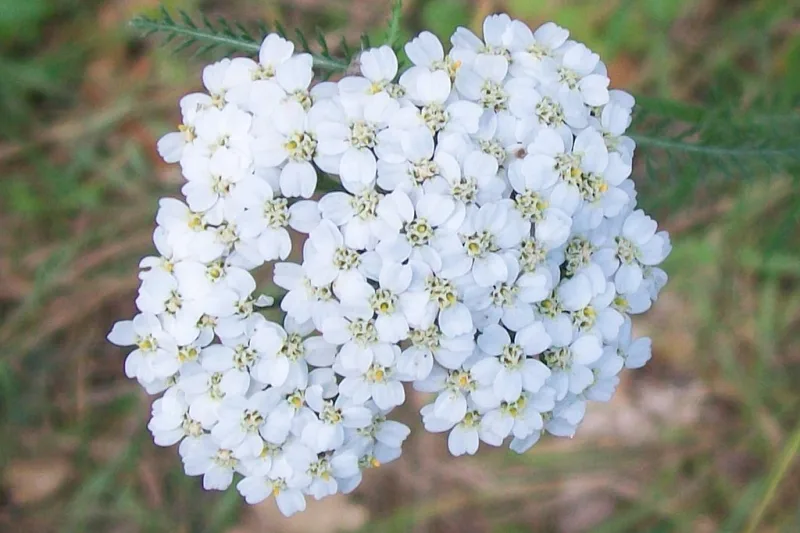
Yarrow belongs to the Asteraceae (composite) family, the same family as chamomile, marigolds and dandelion. It is a hardy plant that tolerates drought and poor soils well, which is why we find it almost everywhere, from the seaside to mountain areas. The stem is upright, hairy, between 30 and 80 centimetres tall, and at its tip it carries flat clusters made up of numerous small flowers, usually white, sometimes pale pink.
For medicinal use, the flowering aerial parts are harvested in midsummer, when the plant contains the highest concentration of volatile oils. Harvesting is done in dry weather, after the dew has lifted, and drying takes place in the shade, in an airy spot protected from direct sunlight, which would degrade the active principles. Once dried, the plant keeps its properties for about a year if stored in paper bags or glass jars, in the dark.
The yarrow flower has an aromatic, slightly pungent smell, and the tea has a characteristically bitter taste that betrays the presence of the bitter principles that stimulate digestion. It is precisely this bitterness, even if not everyone enjoys it, that is an important part of the plant’s therapeutic action.
Composition and active principles
Yarrow’s value lies in the richness of its active substances, many of which act in complementary ways. Phytochemical studies suggest that the plant contains a remarkable combination of compounds:
- Volatile oil rich in azulenes (especially chamazulene, which forms during distillation and gives a bluish tint), pinene, cineole and borneol. Azulenes are associated with anti-inflammatory and soothing effects.
- Flavonoids (apigenin, luteolin, rutin) with antioxidant and antispasmodic roles, helping to relax smooth muscle.
- Sesquiterpene lactones (achillein, achillicin), largely responsible for the bitter taste and for stimulating digestive secretions.
- Tannins, which explain the astringent, blood-staunching and tissue-tightening action.
- Organic and phenolic acids, along with mineral salts and a modest amount of coumarins.
This complex makeup means that the plant works on several levels at once: it soothes inflammation, regulates muscle tone, stimulates digestion and supports the tissues’ healing processes. Folk tradition observed these effects empirically long before the laboratory could name them.
The health benefits of yarrow tea
Support for digestion
The best-known benefit of yarrow tea is connected to the digestive system. The bitter principles stimulate the secretion of saliva, gastric juice and bile, preparing the body for more efficient digestion. A bitter tea drunk before meals can help with the feeling of bloating, with sluggish digestion after fatty foods and with a poor appetite. Folk tradition also recommends it for cramps and intestinal spasms, thanks to the antispasmodic effect of the flavonoids, which relax the smooth muscle of the digestive tract.
Regulating the menstrual cycle and premenstrual discomfort
In traditional medicine, yarrow is considered one of the most important “women’s herbs.” It is said to help regulate menstrual flow and to ease the cramps that accompany menstruation. The antispasmodic and mildly bitter effects seem to contribute to reducing pain, while its action on circulation may explain why it was used both for excessively heavy periods and for delayed ones. Studies suggest that the plant’s flavonoids have a relaxing effect on the uterine muscle, which may underlie these traditional uses.
Effect on circulation and blood pressure
Grandmothers used to say this tea “set the blood moving,” and modern herbalism recognises yarrow’s supporting role in peripheral circulation. The plant has been traditionally used for cold feet, for a feeling of heaviness in the limbs and as an aid for varicose veins. Some observations suggest it may have a mild blood-vessel-relaxing effect, which is why people taking blood-pressure medication should be cautious and consult their doctor first.
Soothing and anti-inflammatory effect
The azulenes and flavonoids give the tea a calming character. Tradition uses it for mild restlessness, to encourage more peaceful sleep and to soothe internal irritation. Applied externally as a compress, the cooled tea has been used for skin inflammation, for tired eyes and to calm irritated areas.
Support during colds and feverish states
Yarrow is, alongside elderflower and mint, part of the traditional blends recommended at the first signs of a cold. It was believed that a warm tea drunk in the evening helps the body sweat and thus “drive out” the illness. The diaphoretic action (stimulating perspiration) was especially valued in mild feverish states, when the goal was to help the body regulate its temperature.
Skin and wound care
Ever since Achilles, yarrow has carried the reputation of the “herb of wounds.” Its tannins give it astringent and mildly blood-staunching properties, which is why fresh, crushed leaves were applied directly to small cuts and scratches. The concentrated, cooled tea was used to wash wounds, for oily and acne-prone skin, and as a mouthwash for sensitive or inflamed gums.
Traditional uses
In the peasant household, yarrow had dozens of uses. It was made into teas for the stomach and for “cleansing the blood” in spring, sitz baths for women’s discomforts, compresses for animals’ wounds and even blends for keeping clothes free of moths. The dried flowers went into the “house tea,” a universal blend that every family kept on hand for minor troubles.
Yarrow tincture, obtained by macerating the plant in alcohol, was kept in dark bottles and used a few drops at a time as needed. The oil in which the flowers were macerated served for massages and skin care. And vinegar scented with yarrow was considered a good tonic for the hair.
How to prepare yarrow tea correctly
Correct preparation makes the difference between an effective tea and a lifeless one. Here is the classic method, step by step:
- Measure the herb. For one cup (about 250 ml), use one heaped teaspoon of dried herb (or two teaspoons of fresh, chopped herb).
- Heat the water. Bring the water close to boiling point, then turn off the heat. Vigorously boiling water can degrade some of the delicate volatile oils.
- Pour over the herb. Pour the hot water over the herb, in the cup or in a vessel that can be covered.
- Cover and let steep. Covering is essential: it prevents the aromatic oils from evaporating. Let the tea steep, covered, for 8 to 10 minutes.
- Strain. Filter the tea through a fine strainer or a cotton sieve.
- Sweeten moderately, if you wish. A teaspoon of honey added after the tea has cooled slightly makes the bitter taste more pleasant. Honey should not be added to boiling liquid, in order to preserve its properties.
For digestive effects, the tea is drunk plain, without sweetener, 15 to 20 minutes before a meal, precisely so that the bitterness can do its work of stimulating the secretions.
Decoction for external use
When the plant is intended for a compress or a bath, a more concentrated decoction is prepared: two tablespoons of herb to 500 ml of water, kept over low heat for 5 minutes, then left to steep, covered, for another 10 minutes. After cooling, the strained liquid is used for washes, compresses or added to bathwater.
Homemade tincture
For a tincture, fill a jar halfway with chopped dried herb and cover it with food-grade alcohol of 40 to 50 percent. Leave it to macerate for 2 to 3 weeks, in the dark, shaking daily, then strain. It is traditionally taken as 10 to 15 drops diluted in a little water, once or twice a day, for short periods and only by healthy people.
When and how much to drink
For an ordinary course, the amount traditionally recommended is one to three cups a day, drunk throughout the day. For digestive support, the ideal moment is before meals. For the soothing effect, one cup in the evening is enough. For menstrual discomfort, the tea can be drunk in the days before and during the first days of the cycle.
As a general rule, courses with medicinal plants are not kept up indefinitely. A reasonable period is two to three weeks, followed by a break of at least a week. This alternation prevents the body from getting used to the plant and avoids any accumulation effects. Yarrow is not a plant to drink daily, for years on end, without interruption.
Combinations with other plants
Yarrow gets along well with many other plants, and the blends can be adapted to the purpose:
- For digestion: yarrow + chamomile + mint. A gentle blend that soothes the stomach and reduces bloating.
- For colds: yarrow + elderflower + linden. The classic combination to encourage perspiration and ease mild feverish states.
- For women’s discomfort: yarrow + lady’s mantle (Alchemilla) + lemon balm. A traditional blend for regulating and soothing.
- For a calming effect: yarrow + lemon balm + St. John’s wort (with caution regarding sun exposure).
When combining plants, keep equal proportions and use about one teaspoon of the blend per cup in total.
Lifestyle and practical tips
No tea, however precious, works on its own. Yarrow gives its best results when it accompanies a balanced lifestyle. For digestion, the rhythm of meals, slow chewing and avoiding evening excess matter enormously. For menstrual discomfort, gentle movement, hydration and rest are irreplaceable allies. For circulation, walking and avoiding prolonged standing complete the plant’s action.
A pleasant habit is to build your own supply of the herb, either by carefully gathering it from clean places, far from roads and treated crops, or by buying it from trustworthy sources. A quality herb has a greyish-green colour, an aromatic smell and well-preserved flowers. Faded, scentless or dusty plants have lost much of their value.
Practical Tips and Common Mistakes
Mistake no. 1: Boiling the flowers for a long time. Many people put the herb directly into boiling water and let it bubble for minutes on end. The volatile oils, which are precisely the most valuable part, evaporate this way. The flowers are scalded and left covered, not boiled.
Mistake no. 2: Leaving the cup uncovered. If you leave the cup uncovered, the aroma and active principles disappear along with the steam. Always cover the vessel while steeping.
Mistake no. 3: Drinking it during pregnancy. This is probably the most important precaution. Yarrow is not recommended for pregnant women. Tradition and herbal caution exclude it during this period.
Mistake no. 4: Ignoring allergies. People allergic to daisies, chamomile, mugwort or ragweed may react to yarrow. The first tea should be drunk in a small amount, to test tolerance.
Mistake no. 5: Courses that are too long and too frequent. “More” does not mean “better.” Prolonged courses without breaks can become problematic. Respect the breaks and do not exceed reasonable amounts.
Mistake no. 6: Mixing it with medication without advice. Those taking blood thinners, blood-pressure medication or sedatives should talk to their doctor to avoid interactions.
Mistake no. 7: Harvesting from roadsides. Plants gathered from polluted places accumulate heavy metals and unwanted substances. Gather only from clean areas.
Conclusion
Yarrow tea is a beautiful example of folk wisdom partly confirmed by modern research. Bitter and aromatic, it supports digestion, soothes women’s discomfort, aids circulation and brings a note of calm to busy days. Our grandmothers valued it as a trusted friend of the house, and its worth endures across generations. Like any medicinal plant, however, it demands respect: moderate dosage, breaks, attention to contraindications and, above all, the common sense to use it as a support rather than a replacement for medical care. Used with measure and good judgement, yarrow tea remains one of the most reliable treasures in nature’s pharmacy.
Frequently Asked Questions
How many cups of yarrow tea can I drink per day? Traditionally, one to three cups a day are recommended, drunk throughout the day. For the digestive effect, the tea is drunk before meals. It is not advisable to exceed this amount or to take very long courses without breaks.
Can I drink yarrow tea during pregnancy? No. Yarrow is not recommended during pregnancy, because tradition and herbal caution consider it a plant that may influence the uterus. During breastfeeding it should also be used only on a doctor’s recommendation.
The tea tastes bitter. Is that normal? Yes, the bitterness is characteristic and comes from the plant’s bitter principles, the very ones that stimulate digestion. You can soften it with a little honey added after the tea has cooled, but for the digestive effect it is preferable to drink it plain.
Does yarrow tea help with menstrual cramps? Folk tradition recommends it for easing cramps and regulating the cycle, thanks to the antispasmodic effect of the flavonoids. Studies suggest a relaxing effect on smooth muscle. If the pain is severe or unusual, it is important to consult your doctor.
How long should the tea steep? The scalded flowers are left to steep, covered, for 8 to 10 minutes, after which they are strained. Covering the vessel is essential to preserve the volatile oils.
Can it cause allergic reactions? Yes, especially in people sensitive to plants in the Asteraceae family (daisies, chamomile, mugwort, ragweed). In some people it may also increase the skin’s sensitivity to sunlight. It is recommended to test with a small amount at first.
Can the tea also be used externally? Yes. A more concentrated decoction, cooled and strained, is traditionally used for compresses on irritated skin, washes, mouthwash for sensitive gums or added to bathwater.
How do I store the dried herb? In paper bags or glass jars, in the dark and protected from moisture. This way it keeps its properties for about a year. Check the smell periodically: a plant without aroma has lost its value.